Sunday, February 18, 2024

Birth Story for Baby #8 - Late First Trimester Miscarriage + Hospitalization for Postpartum Sepsis


Every baby deserves his own birth story, even those with unhappy outcomes. Please do not read if you mind blood and personal details, and please do not read if you yourself are pregnant.

*   *   *

Last March, I found - to my infinite surprise - that baby #8 had joined the party. I really wasn't expecting a new little one soon - or, considering my age (41 at the time), perhaps at all. It was a bit of a shock.

My pregnancy nausea started that same afternoon - as always, suddenly and definitely. My reaction to this was intense irritation, as in, Really? I don't even have time to tell my husband before this nonsense starts up again - AS USUAL? (I have rather lost my patience with pregnancy nausea, as you may infer.) Unfortunately, it was real, strong, and following the usual pattern of growing intensity. Depressing.

However, this is not an entry about pregnancy nausea. Suffice it to say, over the following several weeks I made an exciting discovery of something that really helped with pregnancy nausea, and I shared about that in this blog post. I hope to learn more with time, and should we be blessed with another child, I will post about how pregnancy nausea goes in that pregnancy. But moving on with the story of this baby...

Besides nausea and fatigue, the pregnancy proceeded normally through the spring. And then, at 10w6d, everything changed. On that day, I noticed the faintest tinge of pink staining. 

Blood. 

Just the tiniest amount. But, as any mama knows, blood during pregnancy is really, really not good. Sure, it can stem from any amount of innocent causes. But on the whole, it is usually a sign that something is wrong. 

And thus began one of the wildest and most stressful weeks of my life. I said nothing to my husband, and prayed that nothing would come of it. But the next day (11w0d), it was back. And there was more. The next day, more. At that point (11w1d), I sat down with my husband and said, "I don't know how to say this, but I think that there is a chance that we are going to lose the baby." He was devastated - but, as is his wont, inclined to look on the bright side and be hopeful. (In all life situations, I am the dark pessimist/realist, and my husband is the carefree sunny optimist. It's how we roll.)

I prayed so hard that week. Over and over, God, please spare this child. Please let the bleeding stop. Praying all day, and then waking up in the night, and praying some more. 

I also contacted our midwife and let her know what was going on. She and I both knew that there was nothing that could be done, but she was sympathetic, and she stayed in touch with me.

On Friday, the spotting really picked up, and it also changed from pink to red. We knew that - barring a miracle - a miscarriage was going to happen, and we needed to prepare for it. 

The first thing that we did was to get in touch with one of our priests, and he gave us a lot of really valuable direction. He told us, firstly, that our baby needed a name. This surprised me, as I had not really thought seriously of naming a child whose gender could not be known. (I know that there are early gender tests, but we were not planning on using any of them.) However, he said quite firmly that no, each baby needs his own name. So, after some brief discussion, we picked a name - John Paul Thomas, after both John Paul II and my favorite disciple (being a born doubter, how could I not love the apostle Thomas?). 

(If baby was indeed a girl, then I suppose it would change to something like Joanna - not my first pick, with apologies to all Joannas in the crowd, but it would do. As I said, we were in a hurry.)

(Later, in looking up feminine variants of the name John, I found the following as options: "Jackie, Jacqueline, Jana, Jane, Janet, Jeanne or Jeannie, Joan, Joanna or Johanna." Good to know.)

This was quite different than our usual naming process, which usually stretches for months at a time. But this time we were in a time crunch, and we found our name within 20 minutes.

It was very odd - nightmarish, actually - to be picking a name for a child who one believes may be born dead. And there was still that bit of hope - maybe this will all stop, and everything will be okay. But one way or the other, we had no time - it was an incredible rush.

Secondly, our priest gave us the name of a cemetery that accepts pre-born babies for burial, and we got in touch with them. They were wonderful - we really appreciated their sweet and compassionate communications with us - but we found that they accepted only children for burial who were born at 20 weeks gestation or later. So this was something that was put off for later.

On Saturday morning, my bleeding was really picking up, and I knew with finality that this was really going to happen, sooner or later. When the rest of the family headed out the door for our daughter's morning at ballet lessons, not knowing anything else to do, I just sat down to wait. And within just a few minutes of the family leaving, I felt a gentle pop that was identical to SROM (spontaneous rupture of membranes, or one's water breaking), but instead of amniotic fluid, it was a sudden and massive rush of blood. 

At that point, I realized that I had been quite foolish - I had marooned myself in the kitchen, a room in our home that is completely surrounded by carpeted floor. But there was nothing for it but to run for the bathroom, using my skirt as best as I could to staunch the blood. Thankfully I made it there without incident.

However, once I got to the bathroom and started dealing with things, all chaos broke loose. The baby's gestational sac was born immediately - which, not having the ability to deal with it at that time, I set aside. Then I started trying to deal with the blood. 

It's hard to describe the amount of blood that was going on. Even now it's hard to describe. I was frantically trying to make giant pads out of paper towels, which only lasted for a few minutes each, while trying to wipe up blood off of the floor - and, at some points, the walls, as it was hitting the ground that hard. There was blood everywhere.

Afterwards, I realized that I should simply have spent the afternoon sitting in the bathtub. That would have been the only sensible thing to do. However, that was hindsight. In the moment, all I could think about was trying to keep up with the mess. And I was totally unused to blood loss of this variety, so totally unlike a birth, in which there is usually a big rush of blood and fluid, and then the uterus clamps down and the blood flow is reduced to nothing more than a heavy period (or less). This was totally different - the blood just kept coming. 

I realized at the time that there was a danger of hemorrhage, but my thought at the time was that "as long as I'm not light-headed, I'm probably okay." I have no idea if that was true. And I think I may have gotten a little bit giddy. But not being a trained birth professional, I am completely unable to estimate my blood loss. However, when my husband - the next day - saw me lugging a garbage bag full of blood-soaked paper towels out to the trash, he said, "Um, that's a lot of blood." Yes, it was.

The blood flow continued crazy-heavy for about six hours, and then it finally slowed down to a reasonable level, and I was able to start moving around a bit and restarting normal activities.

[One interesting thing was that my morning sickness - which I have heard often stops when an unborn baby dies, prior to the actual loss process - continued unabated through the week of waiting, and did not start to wane until the evening after the miscarriage process began. In all honesty, this was an added source of stress to me, as I kept thinking, "The baby has to be okay. I'm still sick," - which was not at all true.] 

The following day was Mother's Day. (A word to the wise: Don't go on social media on Mother's Day when you've just suffered a loss.) We held on to our secret for most of the day, and then in the evening told the children the basics: "The baby has died, and Mama is no longer pregnant." They were very sad, and so were we. 


One of our winter Arizona sunsets.

*****

But the story doesn't end there.

That evening, I sat down with my husband and told him that although we had not made it to the end of a healthy pregnancy, I still needed to treat the post-loss time as a "postpartum" period, i.e. trying to stay in bed and rest as much as possible. I knew that I had lost a lot of blood, and that I was also recovering from both a miscarriage and from having been pregnant. He agreed completely.

However, I didn't really take my own advice. Two days later I was up and driving out to pick up our grocery orders. The next day, I drove the crew several towns away for a dance performance. Although I knew I shouldn't, I went back to normal life almost immediately. (Though I did do my best to sit around more than I normally would.) It is surprisingly hard to be still and relax when there isn't a living baby in the picture, with all of the rituals of birth and the demands of breastfeeding a newborn to remind one to slow down. I'm afraid I didn't slow down nearly as much as I should have.

The miscarriage was on Saturday, and throughout the whole experience, there was very little pain - no more than mild to moderate period-type cramps. However, on Wednesday morning, I experienced severe cramps - what I call "four-Advil-level" cramps. I found this curious, but didn't think much of it. 

But it happened again - this time in the middle of the night (on the same day). Weird.

On Thursday, I got up at my usual time and thought that I was okay. I began my day. But I canceled a doctor's appointment that I had that morning for one our children, without really knowing why. Later in the morning, I went to church for a special service (was it Pentecost? or Ascension Day?), but as soon as the music started, I burst into tears and from there alternated between crying and wondering why was I feeling so incredibly awful? I only lasted about 15 minutes into the service before I simply got up and left. When I got home, I marched into the house, told my husband that I was going back to bed, and did so - and stayed there, just feeling worse and worse.

At some point, my husband came in and gave me the wild-eyed look that meant, "Are you really going to stay in bed when I'm trying to work from home and the children are bouncing off of the walls?" - to which I replied with firmness (and, I'm afraid, grouchy firmness) that I was feeling awful and was not going to be getting up, period. He was puzzled, but he kindly rolled with it. 

At some point, I realized that I was feeling scary-bad, and so I went into the bathroom to try to find a thermometer. (At our house, we can never find a thermometer. Ever. And if we do find one, it is either broken or battery-less, with the kind of batteries that one never, ever has around the house.) Miraculously, though, I did find a working thermometer, and, sure enough, I had a fever. Moreover, it was going up every time I checked it (about every five minutes). 

At this point, I knew that something was really wrong, and that I needed my husband to call our midwife. By that time I was feeling so awful that I didn't feel up to going and getting my husband, so I just prayed that he would come in - and shortly, he did (prayer answered!) and I asked him to call up our midwife. Unfortunately, it turned out that she was on a plane leaving the country on a trip, and she had to forward our request to one of her colleagues. However, that midwife immediately got in touch with us, and told us exactly what I expected to hear - that I had some kind of post-miscarriage infection going on, likely due to retained material, and that we needed to head to the hospital right away. 

And that's what we did. Thankfully one of our children was old enough to babysit, so we were able to be on the road in just a few minutes. I asked my husband if we could travel about 30 minutes away so that we could check in at my favorite hospital, and he graciously agreed. (Here in Phoenix, we are surrounded by hospitals, but I do have a special love for one in particular.) 

When we checked in, we were immediately started in the system. But it's a long process, as anyone who's ever gone to the ER knows. We ended up having every test known to man, in a long process took about ten hours (1:00 p.m. to 11:00 p.m.), and ended up with my being admitted to the hospital for IV antibiotics for a diagnosis of postpartum septic endometritis (sepsis). 

Two of my big worries thankfully turned out to be groundless: (1) I did not have an ectopic pregnancy going on, and (2) there was no retained tissue. Both of those were a big relief. 

I ended up being in the hospital for four days. My stay was lengthened by the complicating factor of my fever returning at the 24-hour mark, a sign that a bug was eluding the current antibiotic regimen, so another antibiotic was added into the mix. A most amusing side-effect of this antibiotic was a strong and unpleasant taste in the mouth - which I at first attributed to my fevered imagination, but later concluded (rightly so, it turns out) that it must have had something to do with the antibiotics.

Being in the hospital, and feeling mostly okay for much of the time, was actually an interesting experience. Though I learn toward naturopathic healing modalities, I have the utmost respect for dedicated medical professionals in the Western system, and I met many wonderful nurses, techs, and doctors. Additionally, I had time for some serious, all-day reading - something I haven't had time to do since college. One day was taken up with a book of Oscar Wilde's plays, and another day was devoted to C. S. Lewis's That Hideous Strength (the third book in Lewis's science fiction trilogy). 

That second day, indeed, was really a spiritual retreat for me - reading, praying, and contemplating. I came to a lot of good conclusions. Mainly, I realized that I needed to stop taking blessings for granted. Children, pregnancy, marriage, health, home life, cooking, cleaning, life in general - all of them are blessings - blessings that can be removed without notice. The life of a large-family homeschool mom is one of never-ending struggles, of exhaustion and being overwhelmed - and personally, I struggle intensely with finding contentment, and avoiding the sin of discouragement. The experience of losing the baby, and temporarily losing my health, my home life, and my family, was a good wake-up call, and the C.S. Lewis reading was an added spiritual experience on top of all of that. I came away from the experience with the feeling that my stay in the hospital had been a blessing. 

I came home from the hospital with oral antibiotics - which, incidentally, made me feel awful - and spent a good couple of months feeling exhausted and rather wretched before perking up in mid- to late summer. I'm not sure if the exhaustion was from the pregnancy, the miscarriage, the blood loss, or the antibiotics - or perhaps all of the above. It was nice to realize that I was finally feeling better after a few months had passed.  

Our church family came around us with a gift of a meal train while and after I was in the hospital, and that was an immense blessing. Ladies, meal ministry is such a blessing to those in your church and community. It is such a good way to support families who are struggling! We felt very blessed during this time, especially as I was feeling too tired and sick for several weeks to cook.

*****

And there you have it - our birth story for baby #8. The outcome was not what we planned or imagined, but the Lord held all in His hands, and we trust His judgment. Each baby is precious; each baby is remembered; each baby has an eternal soul and is precious in the sight of God.

*****

A few reflections to finish up:

(1) Why and how did I come down with postpartum sepsis?

It's an interesting question, and I'm not really clear on any answers. I practiced good hygiene throughout the process, and I have had seven previous pregnancies with no issues of any kind.

In my reading, I did see that postpartum sepsis is more common after hemorrhage. I don't know if I qualify for that, but I did bleed heavily. Additionally, as I noted, I did return to my everyday activities far too quickly following the loss. And there were probably factors at work that I simply will never know.

(2) I have heard for many, many years that miscarriages can be very physically traumatic, and even a danger to one's life.

Folks, they weren't kidding. 

Don't mess around with miscarriages, especially those that happen further on in pregnancy. Respect them and respect the process  and don't be foolish or careless. Miscarriages can be extremely dangerous. 

Additionally, a friend possessing an antique medical book on obstetrics told me that the author of the book wrote strongly that mothers who suffered miscarriages needed to be treated even more carefully than mothers who had completed full-term pregnancies - the reason being that childbirth is the natural and healthy outcome of pregnancy, and thus is lower-risk than a miscarriage, which by definition is the unnatural and unhealthy outcome of pregnancy. Thus, if my habit was - as it is - to stay in (or on) bed for two weeks after a birth, then I should have stayed in bed even longer following a hard miscarriage. Whatever practices I had for a normal birth should have been followed more stringently for miscarriage.

Needless to say, I didn't follow that policy. Perhaps if I had, I would have had a healthier outcome following our loss.


(3) This miscarriage followed a week of prayer and worry. I knew even at the time, that I could have simplified matters by requesting an ultrasound, which my midwives do have available. 

But I didn't. 

Why?

I'm not quite sure. Possibly I wanted to hang on to hope, and not to have to see what I knew I would probably see. Denial.

On a practical level, getting over to my midwives' office would have been a serious headache, requiring me to request my husband to make special arrangements with his work, etc., and I wasn't really up to the challenge (both being a worried wreck and still being quite ill and/or exhausted with pregnancy sickness).

If there's a next time, would I consider it? 

Perhaps.

(4) Similarly, I have learned - and I knew at the time - that there are early baby gender tests (by blood test) that we could have taken advantage of in order to know baby's sex. Normally I am an absolute paranoid freak about not wanting to know baby's gender before birth, but in the case of an impending miscarriage, it might be nice - both for naming and for remembrance. 

Again, I didn't take advantage of this. Why?

And again, I'm not quite sure. Possibly because of the extra cost; possibly because of the extra trouble during a time of grief and physical illness. Possibly because early miscarriage is usually cloaked in mystery - one does not naturally know the sex of babies lost in early miscarriage - and so I didn't feel an overwhelming need to know.

But I would consider it at a future time if it was needed.

(5) Something odd that I noticed:

After the miscarriage, I was overwhelmed with grief. Anything and everything could start the flow of tears - and I am not one for crying. It went like this: Walk around a corner in a store. Start crying. Etc.

But. 

Once I was thoroughly sick and in the hospital and receiving treatment, that overwhelming, soul-stopping grief suddenly evaporated. I do not mean that I no longer grieved - I did. But it became a gentle, longing regret, rather than an unstoppable and uncontrollable physical response. It almost felt like the grief manifested as my physical symptoms of sickness during the sepsis, and left my body. I cannot explain this, but the sudden transition was too abrupt not to notice. 

(6) This was my first real experience with a life-threatening illness. It was mean, it was brutal, and it moved super-fast. This is the first time in my life that I have thought, if it hadn't been for medical intervention, I don't think I would have survived. That's an interesting thought. Two hundred years ago, my cause of death, at age 42, would have been "childbed fever after a miscarriage," and I would have been one of the many women whose deaths were linked to childbearing - a very common fate throughout the course of history. An interesting thought on human mortality. 

(7) Speaking of childbed fever (the historical name for postpartum sepsis), I was speaking to a young OB, later during a follow-up appointment, and found, to my surprise, that she had never heard the phrase "childbed fever." 

What?

Are they no longer teaching history to doctors? Especially to OB/GYN doctors? I found this astounding, as the history of childbed fever is foundational to the development of both obstetrics and modern medicine (sterile technique, handwashing, etc.), and I cannot conceive of someone receiving an 8+ year education in medicine and obstetrics without knowing the history of childbed fever. I found this most curious.

And enough meditations. 

*****

Thank you for sharing this journey with me, dear friends! I know that so many of you have suffered losses of babies during pregnancy, and you are in my thoughts. May God comfort all of those who have lost little ones during pregnancy - and beyond. 


Tuesday, November 14, 2023

Reflections on Endings (Books Lately, August 2023)


I've noticed something that happens every year, in two steps:

(1) I spend all year longing for autumn and the winter holidays,

(2) As soon as September hits, I am so stressed and overloaded that I'm watching the clock till January hits.

Can anyone identify with this?

Seriously, autumn is my favorite season. And I adore the holidays and the liturgical year that progresses from Michaelmas into Advent, through Christmas and Epiphany. I live for all of that.

But it can be a bit much. It's always difficult to make the holiday season special without making myself a stressed-out mess.

Trying to find that right balance, as a mother, is a constant tension. Though I've made progress, I've never done it perfectly (or even well). 

It's an interesting phenomenon to consider.


Our Christmas wreath project from last year. I committed to making two kits of these to sell at our upcoming Christmas craft boutique. Considering that they're due in a week and a half and we haven't started yet.. mmm, well, hmm. 


In other news:

This past month we traveled north for my father to receive military honors at the VA cemetery several hours away from our home. It was an emotional time, especially for my poor mom, who received the folded flag and had to see her husband's ashes laid to rest. It was hard on all of us, but I think it was the worst for her. In seeing her go through all of this, I cannot help but look to the future and wonder if I will be called to the same grief - that of laying a husband to rest, of letting go and saying goodbye till eternity. And if it's not I who am called, it will be my husband who is. Either way, it's a hard truth.

It also brought a lot of thoughts: Primarily, that my dad's pilgrimage here is done. For better or worse, his journey on earth is over. He did a great job, and I could not have asked for a better dad. Doubtless, he made mistakes and committed many sins, many of which he most likely regretted, but now it was time for him to return to his Creator. 

To put it bluntly, each of us will face that same moment of ending, and of reckoning. Our time here is not endless. We feel like it is, and modern society encourages us to think that way ("don't think about death, just buy-buy-buy!"), but mortality - death - is the final reality. At some point, our journey here will be over, and we will, for better or worse, be called home. 

May we use our time wisely and well.


In a similar vein, our eldest graduated from high school this past summer. Like my father's death, our son's graduation was actually quite unexpected. We'd hit some potholes along the way, things were a bit messy, and we really didn't know how or when he was going to graduate. But he decided that the time was now, and he pushed it through. We're very proud of him, and now we wait for the next chapter to unfold. 

But for me, as a teacher, there is the same reckoning. Our educational journey is over. Though it seemed endless, it actually had an endpoint, and we reached it before I realized it. The judgment of how well I did as a teacher - and how well he did as a student - will be in how he chooses to live his life going forward.

How did I do? I'm not sure. My failures were legion. My insufficiencies were too many to count. My regrets are many. At the same time, I can absolutely say that I did the best I could. Furthermore, I have to admit, I was able to give to our eldest far more - in terms of my energy, my time, and my overly-ambitious undertakings - than I shall be able to give to any of our subsequent children. That is sobering, considering how many things with our eldest were wished for but never completed (or even attempted). 

I suspect that a homeschool journey and a life lived are much the same. We do our best - but sin and human frailty play an enormous part. We must do our best and also rely on grace. 

In homeschooling and parenting, as in life, may we use our time wisely and well. 

And now, let's have a few books:


For Teens & Adults

Let's start with an author introduction: Vesper Stamper. Have you heard of her? If not, you should have!

I learned about Vesper Stamper while watching an interview with her:


The interview is utterly fascinating, so if you just scrolled past, go back and watch the video. Seriously.

After enjoying the interview, I checked two of Stamper's books out of our public library - What the Night Sings and Berliners. They both blew me away. Let's check them out:


What the Night Sings: A Novel (Vesper Stamper) - Historical fiction in Nazi Germany and post-war Europe.

A girl grows up in Nazi Germany not knowing, until she and her father are arrested, that she is Jewish. Her father is soon killed, but she herself survives through until Liberation. While the story tells of her childhood and the torments of her incarceration, one of the main focal points of the book is one that is almost universally untold - what happened to concentration camp inmates after they were liberated. For the main character, this involved living in the freed concentration camp, marriage, leaving the camp, and eventually emigrating to the newly-formed nation of Israel. 

Parents will want to preview this book to make sure that a student is ready for this book, as the subject matter is very dark. There is also some gentle sexuality in the telling (mainly G-rated) of a married couple's first night together. On the whole, I'd say that this novel - and the next - are for older teens and adults.


Berliners (Vesper Stamper) - Historical fiction in post-War Berlin during the building of the Berlin Wall.

This book may be considered a sequel to the first, as it continues the life story of the man who was - unbeknownst to the reader in the first book - the betrayer of the main character and her father. He is now married and the father of two boys, and the story continues in Berlin during the days preceding the building of the Berlin Wall. 

Several intertwining themes spanned the length of this book. Firstly, on the part of the parents, the question is asked: What became of the Nazis? Yes, many officials were prosecuted during the Nuremberg trials, but many regular citizens were complicit in Nazi war crimes. Those people went back to their regular lives, but many had to deal long-term with the darkness of their pasts, as the father did in this book.

A second theme is how the two brothers react to the political climate. One enthusiastically and passionately embraces Communism; the other is a skeptic. In the end, they end up on different sides of the Wall.

The book is shocking in that it ends - quite suddenly - with many unanswered questions. What will happen to the parents' marriage? What will happen to the mother? And to the other characters? This is not a Lord of the Rings ending in which each and every story line is neatly and tidily finished up in elaborate detail. Instead, the author leaves you hanging - and it's a very effective way to end a book.

In the interview linked above, Stamper mentions that it takes her several years to write a book. And it shows. The depth of historical research, of really getting into a historical time period, is astounding. The workmanship is superb. You will not need any other resource to study post-war Berlin. 

I read this book so long ago that I cannot remember details about language, sexuality, etc. Again, parents, pre-read. It's super-dark stuff. But this book is certainly the best historical fiction that I've found on the Berlin Wall. In all honesty, it's some of the best historical fiction I've found on any topic. As a wide reader of children's fiction, I can tell you that there is a lot of really mediocre and downright crummy children's (and teen and adult) historical fiction out there. (There are entire series of the stuff.) This is different. It's pure gold. And it was a joy to read. 

Enjoy.


***

And now, onto a few other books!


How to Save the West: Ancient Wisdom for 5 Modern Crises (Spencer Klavan) – Theology, politics, worldview, philosophy, religion.

This book is like fine fudge. It needs to be read in small bites, and savored - because it is so rich, and so good, that it cannot be rushed. This book is a masterpiece, and I highly recommend it. Don't just read it at the library - buy a copy. (Or many copies. And hand them out in public places. It couldn't hurt.)

Highly recommended!


The Ministry of Ordinary Places: Waking Up to God’s Goodness Around You (Shannan Martin) - Christian living.

I was so looking forward to this book, which I found recommended in another book from last month's Books Lately. Not only is the cover absolutely delightful, but I adore books about hospitality. Hospitality is a weak spot with me - I love the idea of it, and I really do try, but I am also an alone-time loving introvert who tends to take out any stress in hermit-like behavior. (Any fellow hermits out there?) So I know that hospitality is something that will always be both a joy and a struggle for me, and I love any encouragement or tips that I can get. 

First, the positives:

The author, Shannan Martin, is very well-intentioned. She is reaching out to people in her community. And the basic message of the book is sound - that we should reach out into our surrounding neighborhoods and communities to invite people into our homes - even people who don't look quite like us. And she is obviously doing a better job at this than I am. 

The negatives:

The book constantly straddles the fence true forms and false forms - between Christianity and progressive Christianity, between hospitality and woke social justice. The author seems to see many or most things in terms of race. Additionally, her language veers into wild and semi-hysterical emotional language that many times doesn't even make sense. (Think Rob Bell.) 

So, alas, I cannot recommend this book. But I do appreciate the author's good intentions. 

If you want a great book on hospitality - though one that will leave you with a racing heart and a permanent guilt trip - try Rosaria Butterfeld's The Gospel Comes with a House Key: Practicing Radically Ordinary Hospitality in Our Post-Christian World.

Does anyone out there have other great books on hospitality to recommend?


 Carry On, Jeeves (P.G. Wodehouse) - Fiction, humor.

 My monthly Jeeves & Wooster fix. Mmmm.

(Sorry, folks, can't figure out the formatting problem with that past entry.)


For Children

More All-of-a-Kind Family (Book #2 in the All-of-a-Kind Family Series by Sydney Taylor) - Non-fiction chapter book of a Jewish family in early twentieth-century America.

After having known and loved the first book from childhood, I am very much enjoying continuing on with the series. This book introduces two new characters - an uncle (whose name I cannot recall) and his love interest, Lena. We enjoyed this very much.

Highly recommended.


Hanna's Cold Winter (Trish Marx) - Lightly fictionalized  non-fiction picture book.

The story, based on a true incident, of how the people of Budapest saved their zoo's hippos during the winter starvation of World War II.

We loved this story, and even more, the illustrations. They are lovely. This book was added to our family booklist (which I am working on every day, and hope to have to share with you in a couple of months!).


From the Kitchen

I seem to be going through a new-recipe boom, so here are some winners to try!

***

I know that this recipe for Homemade Pierogi from King Arthur is a great recipe, because King Arthur doesn't put out bad recipes. 

BUT

I tried to make it with gluten-free flour. And I'm still trying to forget the kitchen scenes that resulted. 

Let's just say that gluten-free flour, while it works for most recipes, just doesn't work for some recipes. Even after I kneaded in a ton of gluccie, it was still a falling-apart mess. And then, to top it off, I went and burned the few pierogi that we were able to salvage.

I will make this recipe again. Just not with gluten-free flour.

***

At some point, I realized that the meat I had thawed to bake was not my usual skin-on chicken thighs, but skinless chicken thighs - which I love for the crockpot, but how on earth does one bake them?

This recipe for How To Cook Boneless, Skinless Chicken Thighs in the Oven was my answer, and it was very tasty.

***

One of our family's favorite recipes, made only for special occasions is Scotch Eggs. We serve them with oven potatoes and baked beans. If you haven't tried Scotch Eggs yet, do give them a try. (We leave out the salt - they're super-salty as-is.)

***

A friend brought us this Chinese Orange Chicken (with rice and stir-fry vegetables) after my father's death. It was delicious, and we hope to try the recipe soon.

***

I recently ran across this recipe for Hawaiian Haystacks - basically, rice, a chicken cream sauce, and then lots of delectable toppings. We tried it and absolutely loved it - my husband immediately asked me to put this into our regular meal rotation. I always love finding meals that are simple, healthy, and include vegetables (especially raw vegetables). For the cream soup, I recommend Pacific Foods for a product with better ingredients.

I also added this recipe to my repertoire of dinners that I take to families. The rice can be taken either dry (so the family can make it fresh) or cooked, the cream sauce goes cold into a plastic container or bag for the family to heat, and the toppings go into individual bags. It's been a success every time.

***

On the day of my father's funeral, I put this Vegetable Barley Soup in the crockpot, headed out for the day, and hoped for the best. The soup was awesome, and the family loved it. It was lovely to walk into a ready-made dinner. (I should do this more often. Usually I don't.)

(If you're going to try this, do the prep work the day before. There's nothing fun about trying to prep a crockpot the morning-of while your children run in circles screaming, not that I would know anything about that, certainly not.)

***

Last week, I ended up with four fresh chickens that had to be cooked right now (primarily because I'd put them in the fridge and forgotten about them for four days, before rushing out in a panic to see if they were still good - which they were, but time was limited). I wanted more of a rotisserie style than a baked style, so I turned to the internet to see if such a thing was possible in a conventional oven - and it was. Easy Rotisserie Chicken, at your service. 

The recipe was easy, fast, and delicious. My plans to freeze the meet for recipes down the road was derailed by the slight issue of my family eating all four chickens. How on earth did they manage that one?

***

One mind-blowing development in the kitchen -  I learned the Holy Grail of how to cook collard greens. Namely, I covered them in water, put them on the stove, and completely forgot about them. As in, all day. When I finally remembered them, I drained most of the water, added some bacon, and let them cook some more. And they were so good that even the children ate them without complaining

Around here, that is a win. 

They were the most delicious green I've ever made. Usually I'm not a huge fan of collards, because they simply stay leathery. Long and slow cooking (and bacon!) seems to be the answer.

***

And finally, I tried something new - making an ice cream cake! It was an enormous hit at our 9yo's birthday, and the whole family was entranced with a homemade ice cream cake. To my surprise, making an ice cream cake was easier than making a regular decorated birthday cake - no lie! It just took a bit longer. I recommend a three-day process (four-day if you really want to stretch it). 
  • Day 1 = Bake the cake, slice and freeze.
  • Day 2 = Assemble. (Depending on how many ice cream flavors you use, this can take many steps. We used only one ice cream, so it wasn't too long.)
  • Day 3 = Eat.

Two tips that I learned: The above recipe uses a spring-form pan for assembly, which would be awesome, but I didn't have a matching cake pan (mine are 8" and 10") and springform (mine is 9"). So I just used the cake pan for assembly, lifting the cake out with the plastic wrap handles when it was done, and it worked just fine.) Also, I found that I needed more whipping cream than the recipe called for in order to frost the cake (recipe = 1 1/2 cups, what I needed = 2 to 2 1/2 cups).

Enjoy. 


Enjoy the recipes and the books, dear friends! I'll see you soon, and until then, pray for me, as I pray for you!


Saturday, October 14, 2023

Joining the one club I did not wish to join (Books Lately, July 2023)


This past month, I joined the one club that I did not wish to join - that cohort of people who have lost a parent to death. My father died, after a short and intense illness, in the first week of October.

I have been dreading this moment for over twenty years, and it really was as bad as I thought it would be. The Lord carried us through, but it was rough.

In many ways, I think that I unconsciously saw it coming for quite some time - perhaps as much as a year or a year and a half. My father recently reached the five-year mark from his stage 4 cancer diagnosis (putting him in the less-than-ten-percent survival likelihood category), and this was a major milestone. 


But he simply wasn't looking well, or acting normally. And he seemed to be aging rapidly - thinner, more delicate, less energetic, less talkative. I'd noticed this, and been concerned about it, but had hoped that it was just him feeling tired after radiation therapy. 

When it all came crashing down last week, then, it was a surprise and not a surprise at the same time. However, it was all over so incredibly quickly. (Time of terminal prognosis to death: 10 hours.) I think we are all still in shock.

I will share my thoughts on all of this a bit later. But for now, thank you to those of us who were praying for us last month, and to those of you who are always so kind and supportive to our family. It's been a long month.


And now, let's share a few books:


Pygmalion (George Bernard Shaw) – Drama, humor.

I had always thought that the film "My Fair Lady" was based on a book, but in reading this I found that nope, it was actually written as a dramatic script from the first. Thus, reading this book is the same as reading the movie script - plus more dialogue, and minus the songs. A wonderful read!

For those who enjoy "My Fair Lady," try the film "Pygmalion," which is an excellent earlier and non-musical film version of the play. We enjoy it just as much - sometimes more! - than "My Fair Lady," the musical numbers of which can sometimes feel a tad on the interminable, wonderful as they are. (Is that heresy?)


The Checklist Manifesto: How To Get Things Right (Atul Gawande) - Non-fiction.

After discovering this author and enjoying one of his books so much, I ran straight to my library website and borrowed every other of his books that they had in the catalogue. Enter "The Checklist Manifesto" - a book written in praise of the humble checklist.

At first glance - what? A book about checklists? Have we entered into the last stages of banality and insanity?

But wait, there's more to it than that. Checklists are immensely important - far more important than we know - and they play intensely important roles in saving lives and making complicated multi-person multi-step processes end with success rather than catastrophe.

The book covers the uses of checklists in several major arenas - primarily medicine (especially patient care and surgery), aviation, architecture, and finance. The stories that illustrate the points are fascinating and illustrate the point that the author makes - that checklists are a simply but essential tool in the hands of professionals in all fields.

I was surprised that the author did not include an application into the everyday - that is, how checklists could be useful in day-to-day life for the average person. No such application was made. However, I think that it would not be difficult for the reader to make that translation from professional life into private life - regardless of the particular situation, checklists are awesome.

As a side note, when this past month's situation with my father's health crisis crashed down upon us, I was very thankful that I had, several months previously, read the author's Being Mortal: Medicine and What Matters in the End. You can read my review of that book here. In short, the book covers elder care, healthcare in challenging situations, and end-of-life care. As I wrote in my review, 

"I enjoyed this book thoroughly, and recommend it to all, because the material is pertinent to all. All of us will have loved ones getting older or in end-of-life situations, and all of us will one day face the same situation for ourselves. Although the topic is uncomfortable, it's good to think about it before one is in the thick of decision-making and difficult choices."

When I wrote those lines, I had no idea that a few short weeks later, we would be facing end-of-life care decisions for my father. Thankfully, there weren't too many decisions to make - it was very straightforward. The cancer was back, it had spread, and there was really nothing that could be done. (We did have a surgeon coming in to discuss a last-ditch surgical solution attempt - as it turns out, his visit was only about three or four hours before my father's death. Thankfully they didn't press for it.) But it was good to have the material already in my head. 

All of this has really brought to mind the fact that it's so important to make end-of-life decisions, and understand end-of-life issues, before they are staring you in the face. Downsizing, making a will, choosing a burial location, etc. - all of that is so important. And some of that we have not yet done ourselves, so I am preaching to myself as well as to my audience.

I highly recommend both books! 


Up From Slavery (Book T. Washington) – Autobiography.

This book is the autobiography of Booker T. Washington, starting with his birth and childhood in slavery, his family's transition to freedom after emancipation, his search for education, and his eventual transformation into the patron of the Tuskegee Institute, a school and vocational training school for black young people.

The pace of the book is gentle and slow. Some find it too slow, but I enjoyed it greatly. It is a careful and painstaking work that is careful in recording historical details and the author's thoughts. I did find the ending chapters, which dealt mostly with Washington's speaking duties, a tad on the uninteresting side - but on the whole, it was excellent.

I also very much respected how Washington maintained loving relationships with both black and white citizens. He refused to be drawn into the "us vs. them" mentality. This is, to my mind, highly praiseworthy. 

I highly recommend this work! 


Thank You, Jeeves (P.G. Wodehouse) - Fiction, humor. 

A month without Jeeves & Wooster is, by definition, a wasted month. This was my preventative measure against wasting the month of July! (As always, highly recommended.)


What books have you all read this month, dear readers? If you have any to recommend, let me know!


Film Corner

Recently, I have been having our family watch movie versions of some of the books that our high schooler read during the past school year. Last month, we worked our way through two versions of Jane Austen's "Emma" - the two 1996 versions, to be specific.

Here is the Kate Beckinsale 1996 version:


And here is the Gwyneth Paltrow 1996 trailer (sorry, all, couldn't find the full film):


To my infinite surprise and pleasure, the 17yo immediate said that he preferred the Kate Beckinsale version. In fact, for several weeks he went about going into long speeches on the subject, which I found most amusing. 

I actually enjoy both of these versions, and have seen them both many, many times (back from the days when my husband and I actually had time to watch television by ourselves). However, I have come to prefer the Beckinsale version, due to (1) historicity, (2) lack of imported modern dogmas, (3) more subtlety and nuance of character and writing. Additionally, I find that in the Paltrow version almost every sentence seems to be covertly telling the presumably unread viewer something that he or she would be incapable of otherwise knowing or finding out individually. (Example: Emma says: "Mr. Knightly, how is your brother treating my sister?" Lesson for viewer: Emma and Mr. Knightly are in-laws by marriage. I wouldn't mind an occasional foray into lines such as this, but they seem to abound over and above what is necessary. Watch for it, and you'll see what I mean.)

I would love to hear your views on the different Jane Austen films out there. I know there are so many good ones! (And some really bad ones.) Which are your favorites? Which do you recommend?


Musical Notes

Have you all heard of the YouTube musician Julian Neel? He specializes in barbershop and other wonderful four-part harmony numbers. We especially enjoy his early-1900s pieces. Here are a few to get you started:


From the Kitchen

This month I made a chocolate peanut butter pie for my husband's birthday - it's one of his favorites, and we all love it. 

For the chocolate graham crust, I ran into a snag - Walmart has apparently stopped carrying chocolate graham crackers. Crumbs! But hastened I to the internet, to find, as I suspected, that one could indeed make a chocolate graham crust out of plain graham crackers. Voila! Give it a try. 

After making the crust, I first fill the pie with a recipe of homemade chocolate pudding. (This is delicious, and helps to make a bigger pie to feed a crowd.) 

After the pudding layer has chilled, I use this peanut butter pie filling for the top layer. The recipe uses only eight ounces of whipped topping in the peanut butter mixture - this time I used 12 ounces to use up a complete container and also make a bigger pie, and it was a success. I also reduced the powdered sugar by half, and that too was a success. 

I find that with most American desserts I can drop the sugar by one-quarter to one-third without the composition suffering - sometimes even by a half! People really don't notice, and we all get less sugar - what's not to love?

The expression of a cat who senses an approaching toddler. "Oh, no, I'm in for it now!"


Have a wonderful month, dear reader! Pray for me, as I pray for you!


Tuesday, October 3, 2023

In Which I Admit to Having a Problem (Books Lately, June 2023)


Yes, a serious problem. I even moved away, but the problem followed me. And so, the only solution is to admit my problem and hope for healing. Here it is...

I am hopelessly addicted to borrowing far more library books than I could ever read. 

Okay, maybe not strictly accurate. I do get around to most of them. But I certainly could stand to calm it down with the maxing-out-the-library-cards bit.

Here is my current waiting list (part of it, at least):


Current subjects of interest include the food and fast food industries, dietary sugar, classic children's books, European politics, and a dabbling in different areas of theology and family life. 

However, come to think of it, it's a good problem to have. So maybe I'll skip the Books-Anon meetings for now.

I am doing my best to catch up with these long-overdue posts, so let's get started with June's books!


For Teens & Adults

The Great Divorce (C. S. Lewis) – Christian allegory.
     How have I gone so long in life without this book? (Answer: I thought I'd read it before.) When I picked it up to "re-read" it, I discovered that I had, in fact, never laid eyes on the material before. While I was at first confused as to what on earth I was reading, I soon picked up the train of thought and devoured the book. When I was done, I read it again - and loved it even more.
     The premise of the book is as follows: What if people in hell had an opportunity - every so often - to leave hell, and then had an opportunity to either return to hell, or continue on the way to heaven?
     
It's an interesting question, and as the narrator follows numerous persons in their decision-making process, we see the answers to the perennial question - why do so many insist on taking the wide road instead of the narrow? Lust, pride, stubbornness - all of those are examined and laid bare. I especially liked the "fire lizard," which seemed to represent a besetting sin or addiction, and which became a steed of life and strength once the person afflicted by it consented to have it slain. Beautiful.
     This definitely falls into the Read it now! category. Highly recommended.

The Lazy Genius Way (Kendra Adachi) - Homemaking, life skills, self-improvement.
     Apparently the Lord wanted me to have a copy of this book, because something like twenty minutes after I brought it home from the library , one of my children thoughtfully poured a glassful of water over it. Result: I bought a new copy for the library, and the crunchy one was mine. And this was a good thing.
     This book is one in a long line of self-help books for the management of daily life, but there's a big difference with this one - the tricks are actually good, foundational, keystone habits that really do help. I'm now on my third reading of this book, and I read just a tiny bit each day as encouragement to keep going and keep trying. It is tremendously encouraging and useful.
     The author of this book identifies as a Christian, which is great. Some things that I ran across in the book, however - such as her ridiculing Christian modesty or talking about "smashing the patriarchy" - just made me sad. (If there's anything that our culture needs, a strengthened sense of Christian modesty and a re-instituted patriarchy would top my recommendations.) But I loved the book anyway, and the author definitely has good things to say about life management.
     This book definitely does not have the beautiful formatting and aesthetics of its sequel, The Lazy Genius Kitchen, which I also love. (See my review here.) I'm guessing that the first book went viral, and the publishers were then willing to spring for the gorgeous formatting of the sequel. However, the content is wonderful, even if the book itself is unaccompanied by the beautiful artwork of its successor. Highly recommended.

Preparation for Adolescence: A Planning Guide for Parents (James B. Stenson) – Parenting.
     We enjoyed this book very much. Highly recommended.

Satisfied: Finding Hope, Joy, and Contentment Right Where You Are (Alyssa Joy Bethke) - Christian living for women.
     I thought I was checking out a book on minimalism and home management. Nope, this was a book about.... well, see the title, and you'll pretty much have it.
    I did wade my way through most of this book, even if I did some serious skimming. The truth is that I find books of this type - heavily feminine, with masses of luscious, emotional language - difficult to get through. 
     There was some good stuff in there. And I do believe that women have the biblical responsibility of writing Titus 2 type materials for other women. Perhaps this type of hyper-emotional literature is. helpful for a different type of woman than myself? On the whole, I prefer to stick to plain "how to be a wife and mother" books written by women for women, and for other spiritual reading stick to books by godly Christian men (who are not usually prone to flights of emotion).
     One thing that really did stick out to me is that it might be better for a book on "finding contentment right where you are" not to be filled to the brim with pictures of a home so breath-takingly gorgeous that Martha Stewart would weep tears of despairing envy. 
     Something thing that I really did love about this book was the small compendium of family recipes at the end of the book. I loved that it was short (not more than 20 recipes) and uber-practical looking, so I made the decision that I would cook through all of them. And I did, too! Or rather, through most of them - I think I missed three to five, perhaps, but I did make all of the rest. With one exception (which was probably my fault), all of the recipes were delicious and well-received. Her curry recipe was my first venture into the world of curry, and it is now a family staple.
     I do not either recommend or not recommend this book. However, I certainly recommend the recipes! 


For Children

All-of-a-Kind Family (Sydney Taylor) - I remember this book with much love from my childhood, and my own children are enjoying it just as much. And now I find, to my infinite surprise, but it is not a single book but an entire series! So now we have the other books to enjoy. 


Music & Film

Have you heard of the musical group Floriani? They are a local group of men who have formed a full-time musical ministry, for the express purpose of revitalizing sacred music in America. (Oh, boy! It could use it!) Here is one of their performances, this one with a more Eastern flair. Visit their YouTube channel for more amazing videos:


***

Back in May, we were supposed to attend a performance of Oscar Wilde's "An Ideal Husband." Due to our miscarriage, I had to miss the performance. Thus, we looked up film versions, and found that there was a 1947 version - available for free on YouTube! - and we greatly enjoyed it. (There is a later 1999 version, but it looked less than clean. Let me know what you thought of it if you've seen that one.)


We also wanted to watch "The Importance of Being Ernest," and found that there is a delightful 1952 version that we'd never seen before. 


Enjoy!

Have a wonderful month, dear friends! Pray for me, as I pray for you! (As in, seriously. It's turning into a rough month over here. I could use the prayers.)

Sunday, August 27, 2023

Summer is Over, and I am Late! (Books Lately, May 2023)

 
The average reader, noting that for crying out loud it's almost September and why are you posting about last May? may wonder why on earth I am so late with this post.

Life, my friends.

And the fact is that I just don't seem to be able to handle staying current with blogging - even just once a month. The messes are so big, and the to-do list so long, that it just doesn't happen. 

But I do enjoy hopping in when I can. 

This has been a busy summer. 

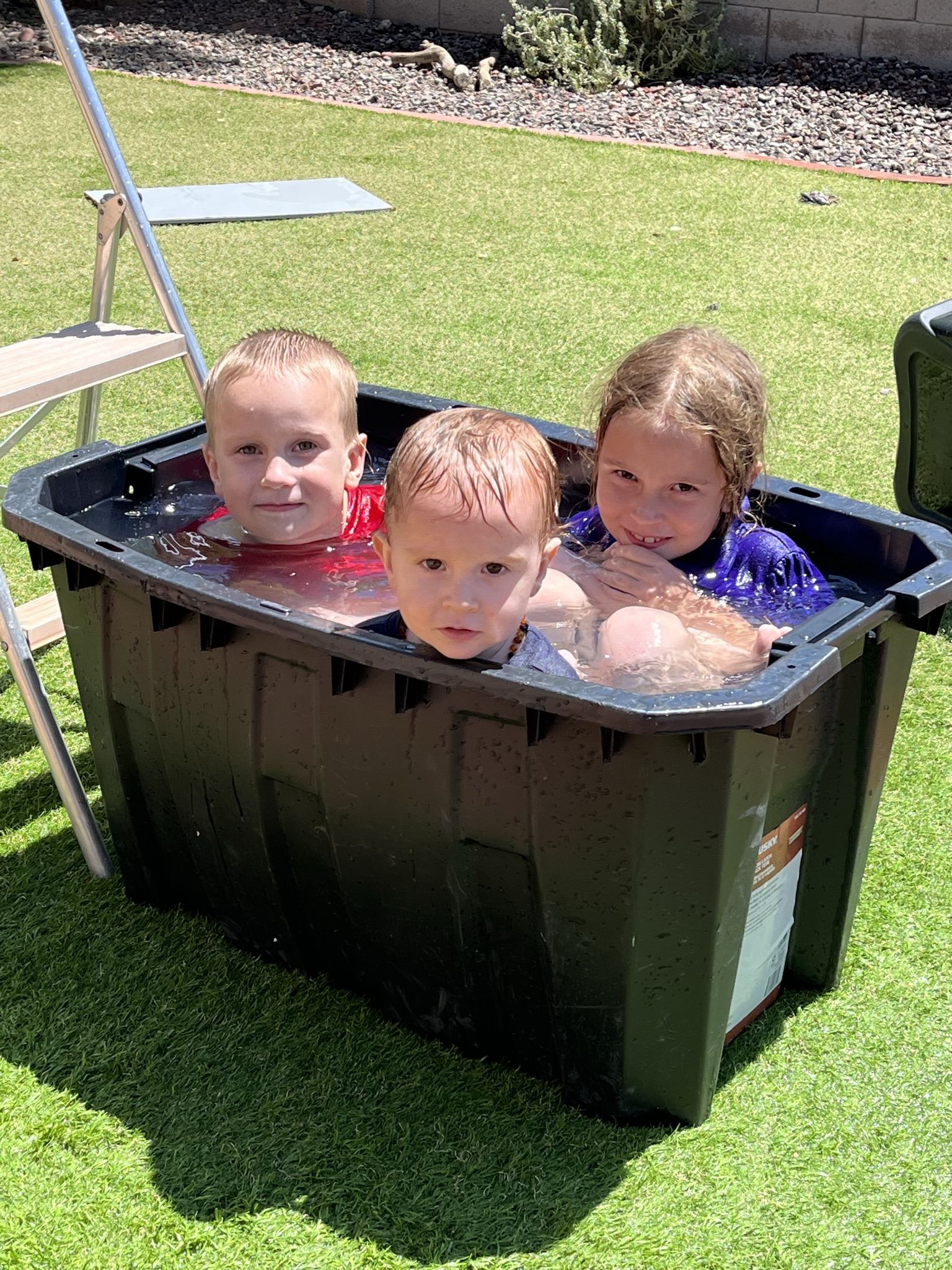
Our low-budget version of a pool. Actually, we did buy a plastic pool later - three, actually, my husband got carried away - but the kids still love the storage container.

A few highlights:

- The eldest turned 17, and the baby turned 2. The eldest, amazingly enough, managed to graduate from high school, and is now working on finding a job and getting a driver's license. The baby - well, his nickname around here is "Trouble." He keeps us hopping.

- The kids attended music camp, and some of our dancers performed in an Independence Day parade.

- We managed a last-minute vacation to the mountains. 

- After working for what seemed like several hundred hours, I managed to find homes for all nine of our kittens. May we say, HUZZAH. (They were adorable little darlings - we were so sorry to see them go - but so glad they all found good homes.) 

** We used the website ReHome to find homes for two of our kitties. It is a great website with supportive staff, and the user interface is super simple and user-friendly. If you use this website to re-home pets, make sure to follow the website's recommended protocol (which includes phone interview, meet-and-greet, waiting period, a signed transfer-of-ownership, and charging a re-homing fee). All of these steps are to weed out the creeps who are looking to get easy free animals to use for base and/or evil purposes (as reptile food, dog fighting bait, animal sacrifice, animal torture, or selling to labs). Evil people are out there, and boy did we find some of them. So follow the steps to keep yourself and your animals safe! ***


One of our little ladies, whom we nicknamed "Cappy" (long story). 

- We made some more big, life-changing decisions for our family. In the last year or two, that seems to have become par for the course. At some point I'll get used to it.

- Several of our crew received Confirmation.

I am currently getting ready for an (extremely!) late start to our school year, complete with an entirely new curriculum set-up. (Translation: I ditched everything we were doing and was extremely happy to do so. It's a long story. If our new set-up works, I'll post about it next year.)


And now, onto books!


For Adults and Teens

Allergy-Proof Your Life: Natural Remedies for Allergies That Work! (Michelle Schoffro Cook, 2017) – Non-fiction health.
   I used to think that allergies were a minor complaint, similar to the "morning sickness" that women made so much unnecessary fuss about. (*Laughs sardonically*) And just as with morning sickness, I thoroughly got my come-uppance with allergies. While I don't get the worst form every year, I have been through the mill with severe seasonal allergies (which here in the Phoenix valley, oddly enough, seem to hit right around Christmas time), and have experienced the lovely type that basically brings life to a screeching halt. This book was a great resource for information about treating allergies naturally, and I enjoyed it greatly. While it goes far further than I hope I ever have to go, I adopted some of the basic strategies this past allergy season, and they helped tremendously (if I am remembering correctly, I avoided dairy and modern wheat like the plague, and added a ton of water and vitamin C to my regimen). Recommended.

Irreversible Damage: The Transgender Craze Seducing Our Daughters (Abigail Schrier, 2021) – Non-fiction sociology.
   I have wanted to read this book for several years, and I finally got my hands on it - and it did not disappoint. While the author is not a Christian - and could even be labeled technically as "pro-trans," in that she does not argue with the idea of adult "gender transitions" - she is addressing a horrendous and oft-ignored phenomenon that is sweeping through our young people - that is, the incidence of "rapid onset gender dysphoria," or gender dysphoria that comes on suddenly, with no history of such feelings or behaviors, almost always after exposure to online trans influencers and communities. She addresses specifically the skyrocketing incidence of this phenomenon in teen girls, and how this is leading to widespread body mutilation (through artificial hormones and irreversible surgeries), and how acceptance of this behavior is now mandated in most levels of our society. As one commenter said, "Science is dead and now social pressure has taken off." 
    As I have observed what is going on in our society, I have realized that had I grown up in current times, I would have been in serious trouble. I was a child with severe social anxiety, social awkwardness, someone who "always knew she was different," and who firmly rejected any feminine frills. (My mother once bought me shoes with bows. I cried.) In terms of the trans movement, I would have been easy prey.
   And here's the thing: Teens can't think long-term. I know I couldn't think long-term with any sort of reality when I was a teen. If someone had said to me, "Here are these drugs and surgeries that will prevent you from being able to have children or breastfeed," I would have said a big who cares. Pregnancy and breastfeeding meant nothing to me at that point. I could not realistically conceive of my future as a mother. But now, many years later, I have spent the past eighteen years either pregnant, breastfeeding, or both. It is a treasure and a gift from God, something that I can't imagine having forfeited in a burst of teenage immaturity. But I'm pretty sure I might have, given the right circumstances. And the fact that our society is both allowing and pushing this on enormous and growing populations of teen girls is both tragic and criminal. 
   Educate yourself about what's going on. I highly recommend this book. 

A Church in Crisis: Pathways Forward (Ralph Martin, 2020) – Non-fiction. An examination of the crises currently facing the Catholic church - a thorough and excellent treatment, and an extremely well-written one. 
   I first encountered Ralph Martin in his interview on Pints with Aquinas back in 2022, and immediately fell in love with his passion and thoughtfulness. I expected great things from his book, and it did not disappoint. Martin continually amazes me with the thoroughness of his research, and the depth of his knowledge, both of which raise the question: How can one man possibly read and examine so many books in one lifetime? (See the bibliography at the back of his book.) However he does it, he is amazing, and the book is well worth the read. Highly recommended. 

The Importance of Being Earnest and Other Plays (Oscar Wilde, c. 1895) - Drama. The edition that I read contained Lady Windermere's Fan, A Woman of No Importance, Salome, The Importance of Being Earnest, and An Ideal Husband. I had originally picked up the book to read An Ideal Husband only, as I had had to miss a children's production of that play that happened during the week of our miscarriage, but I ended up reading the whole book (I skipped Salome). I actually ended up reading all four plays over the course of one day when I was in hospital. The plays were deliciously funny and, of course, wonderfully witty. And, in fact, I went back and read the book again later just for the joy of it. If you haven't read these plays yet, I recommend them. 

That Hideous Strength: A Modern Fairy-Tale for Grownups (book #3 of 3 in the Space Trilogy, C. S. Lewis) – Fiction/Fantasy. This book was reading for Day #2 in the hospital, and it was a mind-blower. I have read this book only once before, and it was back in high school (so, about 25 years ago), and it was just as powerful as I remembered it. Being able to read it in entirety in a day was - quite literally - like having a mini-spiritual retreat. Lewis is always a winner, every time. And this is one of his most powerful works.
   Because this book is #3 of 3 in the space trilogy, I do recommend reading the first two books before venturing on this last volume. Additionally, a basic knowledge of Arthurian legendry would be helpful before delving in. Be prepared for a bit of a slow start, and then for the ride of your life. Enjoy.

Being Mortal: Medicine and What Matters in the End (Atul Gawande, 2017) - Non-fiction health.       When I saw what this book was about, I nearly put it down and didn't pick it up again. But I'm so glad that I kept reading. Gawande's book is a treasure. In this work, Atul Gawande deals with the subject of elder care and end-of-life care. How does in-home care compare with nursing home care, versus "assisted living" care? How far should treatments be pushed - especially those last-ditch treatments that can be painful, destructive, and ultimately unhelpful when taken too far? His examination of the subject, based on his vast experiences as a physician, and also interwoven with the story of his father's battle with cancer (and his eventual death), was gentle, thoughtful, evidence-based, and excellent.
   My main concern with this book was an ethical one - is he going to push for euthanasia? And my fears on that point were mainly relieved. While Gawande does briefly state that there might be a small place for euthanasia in elder care - a statement that, as a Christian, I completely and utterly reject - he states with great clarity a point that I also would argue - that the option of euthanasia makes elder care and end-of-life care far worse than when that option is not available, simply because euthanasia makes caregivers lazy (my words, not his). In other words, why worry about dignified and complicated end-of-life care plans, when one can just urge a patient to choose death and save everyone the trouble? (And a friend of mine, a health worker who witnessed the aftermath of the legalization of euthanasia in Oregon, told me that this is exactly what did happen.)
   I have seen a similar phenomenon in the hyperemesis world with the "solution" of abortion. Why worry about treating or curing complex hyperemesis, when one can "solve" the problem by killing the baby? In both cases, having an unethical false solution to a problem prevents real problem-solving from happening. It also results in lazy, immoral, and dehumanized care for the patient. In both cases, you can't use murder to get real and dignified solutions to complicated health problems.
   I enjoyed this book thoroughly, and recommend it to all, because the material is pertinent to all. All of us will have loved ones getting older or in end-of-life situations, and all of us will one day face the same situation for ourselves. Although the topic is uncomfortable, it's good to think about it before one is in the thick of decision-making and difficult choices. 
   Having enjoyed this book so much, I found several other books by the same author and am now going through those. One of them, "The Checklist Manifesto: How To Get Things Right," will be included in June's write-up of Books Lately.


Children’s Books

Little Britches: Father and I Were Ranchers (first in an eight-book series by Ralph Moody, c. 1950) - Non-fiction autobiography.
   A friend gave me this series years ago - as in, over a decade ago, I am embarrassed to say - and I have only now gotten around to reading them. They comprised some of my reading during our two months of pregnancy loss and recovery after hospitalization, so it was good that there was a lot of material to chew through. 
   These books are excellent. They have been compared to the "Little House" books, and I would say that that is a good comparison - the time period is slightly later, beginning around 1900 - and covering the author's boyhood, beginning when his family moved west to help improve the health of the father (who had tuberculosis), and following the author through his young adulthood up until his marriage. Included in the series is an unbelievable number of different situations, some of which include:

  • The family's ranch experience, ending with the father's death after a bad chill.
  • The family's life after the father's death, supporting themselves with door-to-door selling of the mother's cooking, a time which included the birth of a posthumous baby, and ends with the family having to leave town secretly to avoid the mother having to testify in a case which might lead to a man's execution.
  • The family's life in a new town in which the mother establishes a laundry business to support the family, and in which the author works in a local store.
  • The author's life with his grandfather when he is sent away to live with him for a time.
  • The author's time working on horse ranches and doing trick riding.
  • Most interestingly for me, as an Arizonan, the author's time as a young man doing stunt falls for the infant movie industry (c. 1920) in Tucson, at a time when it was common for both men and horses to be killed or horrendously injured in stunt falls.
And much more. In our current time of extended adolescence, video gaming, and other unhealthy youth predilections, this book was an amazing testimony to the ability of young people to do amazing, productive things with their lives. It was an amazing testimony.
   My one problem with this series was that there were often processes (ranching, farming, mechanical, etc.) described in great detail and at great length, and I often had absolutely no idea what was going on. This does occasionally happen in the "Little House" books, but it was far more prevalent in this series. I just had to learn to keep going and ignore those descriptions, because to a non-farmer, they were unintelligible - my fault, not his.
   If you haven't yet enjoyed these books, I recommend them. If you've read one or more, please write and tell me your thoughts on them! 

New Faces, New Friends (, last book in the Grandma’s Attic Series) – Biographical novel. The Grandma's Attic series was one of my favorite book series from childhood, and I recommend it most fondly. This last book in the series takes place when Mabel is a young married woman with a baby, and concerns the goings-on of their community in small-town 1800s America.
   My main complaint with this book is that it seems to be out of print! - which is a terrible shame. The first four books in the series are commonly available as a boxed set, but the later books in the series - which are my favorite! - are almost completely out of print. They are available as used copies, but it is a pity that they're not currently being printed. If the world at large is listening, please get these wonderful books back in print! 

Cherry Ames, Student Nurse (first book in the Cherry Ames series) – Realistic fiction.
   I bought a certain number of these books years ago at a used book sale - about seven of them, I think - and then never got around to reading them. As I have really needed extra reading material this spring due to all of the illness and recovery going on around here, I finally got this series out (along with the Little Britches series). Cherry Ames books are quick reads - all of them concerning a young woman who becomes a nurse during World War II. 
   The Cherry Ames series was begun during World War II itself, so the series is at first concerned entirely with the war. In the first book, Cherry is a student nurse. In each book, she progresses - through graduation, into practice, and onto the front lines as an army nurse. As the series passes beyond the end of the war, Cherry ends up in a variety of different non-wartime situations - a different post in each book (nursing home, school, ranch, etc.). Each book contains some type of mystery/adventure and a bit of romance, as well as a few steady characters and a continually revolving cast of new characters from each new location. Think "Nancy Drew" with a nursing theme.
   Though nursing and its duties are often described, the more personal or gruesome aspects were glossed over or ignored - something that I think is good in a children's book series.
   The wartime Cherry Ames books in many ways read like wartime propaganda - so much so that I wondered if they really were written as propaganda. Glowing descriptions of "our brave boys" and "our heroic nurses who sacrifice everything for the glorious cause" (my paraphrases) were both charming and somewhat amusing (they were overdone, but that was understandable).
   I would have no problem handing these books off to a daughter of any age. If you do so, however, don't be surprised if she comes home wanting to be a nurse! 

Bud, Not Buddy (Christopher Paul Curtis) – Realistic fiction. A young orphan boy searches for his father during the Great Depression and Jazz Age South.
   I enjoyed this book greatly. It is well-written, funny, and has a well-planned rhythm and flow that results in a very enjoyable read. Our teen son enjoyed it as well.
   My one concern with this book - and it's not a little one - is that the book is filled to the brim with both off-color references and lying. If a child is truly old enough to roll with this material and not take it as an example, I think it's probably okay. For younger children, I really wouldn't recommend this book.
   Your thoughts?

I would love to hear recommendations for great books that you've read lately (and your thoughts on them). Leave a comment below!


A few words from the kitchen...

Actually, this post is so late that I have no idea what was going on in the kitchen way back in May. Mostly, nothing. I was busy with morning sickness, then miscarriage, and then being in the hospital. For the last half of the month, people from our church were bringing us meals in a wonderful show of support and love that we treasured and appreciated. Which reminds me...

I need to write thank-you notes!

As well as catching up with super-late editions of Books Lately. 

But that seems to be life as a mother. There just isn't time - as in, for anything. (I am writing this with a toddler using me as a jungle gym. It never stops.)

So, in the meantime, have a wonderful rest of the summer. And for you non-Phoenicians, appreciate any temperatures you're having that are less than 115 outside! (Wow, it's been hot around here.)

Love to all!


One of my ongoing projects is making one pie per month this year. I think that I'm on pie #6 or #7 - not bad, especially for me. This one was, I think, apple. 


I make pineapple upside down cake for our yearly Monsoon Day celebration (June 24th, which is also the feast day of John the Baptist). Pineapples, you know! Tropical! Like monsoons are tropical! Except that we live in a desert! So you can clearly see the connection there. Too bad we have gotten exactly zero monsoon rain this year. (Not true, we did get ten minutes once, about two weeks ago. Should make for a very interesting fire season this fall.)


Not sure what this was, but it was apparently important enough to take a picture.