Saturday, October 14, 2023

Joining the one club I did not wish to join (Books Lately, July 2023)


This past month, I joined the one club that I did not wish to join - that cohort of people who have lost a parent to death. My father died, after a short and intense illness, in the first week of October.

I have been dreading this moment for over twenty years, and it really was as bad as I thought it would be. The Lord carried us through, but it was rough.

In many ways, I think that I unconsciously saw it coming for quite some time - perhaps as much as a year or a year and a half. My father recently reached the five-year mark from his stage 4 cancer diagnosis (putting him in the less-than-ten-percent survival likelihood category), and this was a major milestone. 


But he simply wasn't looking well, or acting normally. And he seemed to be aging rapidly - thinner, more delicate, less energetic, less talkative. I'd noticed this, and been concerned about it, but had hoped that it was just him feeling tired after radiation therapy. 

When it all came crashing down last week, then, it was a surprise and not a surprise at the same time. However, it was all over so incredibly quickly. (Time of terminal prognosis to death: 10 hours.) I think we are all still in shock.

I will share my thoughts on all of this a bit later. But for now, thank you to those of us who were praying for us last month, and to those of you who are always so kind and supportive to our family. It's been a long month.


And now, let's share a few books:


Pygmalion (George Bernard Shaw) – Drama, humor.

I had always thought that the film "My Fair Lady" was based on a book, but in reading this I found that nope, it was actually written as a dramatic script from the first. Thus, reading this book is the same as reading the movie script - plus more dialogue, and minus the songs. A wonderful read!

For those who enjoy "My Fair Lady," try the film "Pygmalion," which is an excellent earlier and non-musical film version of the play. We enjoy it just as much - sometimes more! - than "My Fair Lady," the musical numbers of which can sometimes feel a tad on the interminable, wonderful as they are. (Is that heresy?)


The Checklist Manifesto: How To Get Things Right (Atul Gawande) - Non-fiction.

After discovering this author and enjoying one of his books so much, I ran straight to my library website and borrowed every other of his books that they had in the catalogue. Enter "The Checklist Manifesto" - a book written in praise of the humble checklist.

At first glance - what? A book about checklists? Have we entered into the last stages of banality and insanity?

But wait, there's more to it than that. Checklists are immensely important - far more important than we know - and they play intensely important roles in saving lives and making complicated multi-person multi-step processes end with success rather than catastrophe.

The book covers the uses of checklists in several major arenas - primarily medicine (especially patient care and surgery), aviation, architecture, and finance. The stories that illustrate the points are fascinating and illustrate the point that the author makes - that checklists are a simply but essential tool in the hands of professionals in all fields.

I was surprised that the author did not include an application into the everyday - that is, how checklists could be useful in day-to-day life for the average person. No such application was made. However, I think that it would not be difficult for the reader to make that translation from professional life into private life - regardless of the particular situation, checklists are awesome.

As a side note, when this past month's situation with my father's health crisis crashed down upon us, I was very thankful that I had, several months previously, read the author's Being Mortal: Medicine and What Matters in the End. You can read my review of that book here. In short, the book covers elder care, healthcare in challenging situations, and end-of-life care. As I wrote in my review, 

"I enjoyed this book thoroughly, and recommend it to all, because the material is pertinent to all. All of us will have loved ones getting older or in end-of-life situations, and all of us will one day face the same situation for ourselves. Although the topic is uncomfortable, it's good to think about it before one is in the thick of decision-making and difficult choices."

When I wrote those lines, I had no idea that a few short weeks later, we would be facing end-of-life care decisions for my father. Thankfully, there weren't too many decisions to make - it was very straightforward. The cancer was back, it had spread, and there was really nothing that could be done. (We did have a surgeon coming in to discuss a last-ditch surgical solution attempt - as it turns out, his visit was only about three or four hours before my father's death. Thankfully they didn't press for it.) But it was good to have the material already in my head. 

All of this has really brought to mind the fact that it's so important to make end-of-life decisions, and understand end-of-life issues, before they are staring you in the face. Downsizing, making a will, choosing a burial location, etc. - all of that is so important. And some of that we have not yet done ourselves, so I am preaching to myself as well as to my audience.

I highly recommend both books! 


Up From Slavery (Book T. Washington) – Autobiography.

This book is the autobiography of Booker T. Washington, starting with his birth and childhood in slavery, his family's transition to freedom after emancipation, his search for education, and his eventual transformation into the patron of the Tuskegee Institute, a school and vocational training school for black young people.

The pace of the book is gentle and slow. Some find it too slow, but I enjoyed it greatly. It is a careful and painstaking work that is careful in recording historical details and the author's thoughts. I did find the ending chapters, which dealt mostly with Washington's speaking duties, a tad on the uninteresting side - but on the whole, it was excellent.

I also very much respected how Washington maintained loving relationships with both black and white citizens. He refused to be drawn into the "us vs. them" mentality. This is, to my mind, highly praiseworthy. 

I highly recommend this work! 


Thank You, Jeeves (P.G. Wodehouse) - Fiction, humor. 

A month without Jeeves & Wooster is, by definition, a wasted month. This was my preventative measure against wasting the month of July! (As always, highly recommended.)


What books have you all read this month, dear readers? If you have any to recommend, let me know!


Film Corner

Recently, I have been having our family watch movie versions of some of the books that our high schooler read during the past school year. Last month, we worked our way through two versions of Jane Austen's "Emma" - the two 1996 versions, to be specific.

Here is the Kate Beckinsale 1996 version:


And here is the Gwyneth Paltrow 1996 trailer (sorry, all, couldn't find the full film):


To my infinite surprise and pleasure, the 17yo immediate said that he preferred the Kate Beckinsale version. In fact, for several weeks he went about going into long speeches on the subject, which I found most amusing. 

I actually enjoy both of these versions, and have seen them both many, many times (back from the days when my husband and I actually had time to watch television by ourselves). However, I have come to prefer the Beckinsale version, due to (1) historicity, (2) lack of imported modern dogmas, (3) more subtlety and nuance of character and writing. Additionally, I find that in the Paltrow version almost every sentence seems to be covertly telling the presumably unread viewer something that he or she would be incapable of otherwise knowing or finding out individually. (Example: Emma says: "Mr. Knightly, how is your brother treating my sister?" Lesson for viewer: Emma and Mr. Knightly are in-laws by marriage. I wouldn't mind an occasional foray into lines such as this, but they seem to abound over and above what is necessary. Watch for it, and you'll see what I mean.)

I would love to hear your views on the different Jane Austen films out there. I know there are so many good ones! (And some really bad ones.) Which are your favorites? Which do you recommend?


Musical Notes

Have you all heard of the YouTube musician Julian Neel? He specializes in barbershop and other wonderful four-part harmony numbers. We especially enjoy his early-1900s pieces. Here are a few to get you started:


From the Kitchen

This month I made a chocolate peanut butter pie for my husband's birthday - it's one of his favorites, and we all love it. 

For the chocolate graham crust, I ran into a snag - Walmart has apparently stopped carrying chocolate graham crackers. Crumbs! But hastened I to the internet, to find, as I suspected, that one could indeed make a chocolate graham crust out of plain graham crackers. Voila! Give it a try. 

After making the crust, I first fill the pie with a recipe of homemade chocolate pudding. (This is delicious, and helps to make a bigger pie to feed a crowd.) 

After the pudding layer has chilled, I use this peanut butter pie filling for the top layer. The recipe uses only eight ounces of whipped topping in the peanut butter mixture - this time I used 12 ounces to use up a complete container and also make a bigger pie, and it was a success. I also reduced the powdered sugar by half, and that too was a success. 

I find that with most American desserts I can drop the sugar by one-quarter to one-third without the composition suffering - sometimes even by a half! People really don't notice, and we all get less sugar - what's not to love?

The expression of a cat who senses an approaching toddler. "Oh, no, I'm in for it now!"


Have a wonderful month, dear reader! Pray for me, as I pray for you!


Tuesday, October 3, 2023

In Which I Admit to Having a Problem (Books Lately, June 2023)


Yes, a serious problem. I even moved away, but the problem followed me. And so, the only solution is to admit my problem and hope for healing. Here it is...

I am hopelessly addicted to borrowing far more library books than I could ever read. 

Okay, maybe not strictly accurate. I do get around to most of them. But I certainly could stand to calm it down with the maxing-out-the-library-cards bit.

Here is my current waiting list (part of it, at least):


Current subjects of interest include the food and fast food industries, dietary sugar, classic children's books, European politics, and a dabbling in different areas of theology and family life. 

However, come to think of it, it's a good problem to have. So maybe I'll skip the Books-Anon meetings for now.

I am doing my best to catch up with these long-overdue posts, so let's get started with June's books!


For Teens & Adults

The Great Divorce (C. S. Lewis) – Christian allegory.
     How have I gone so long in life without this book? (Answer: I thought I'd read it before.) When I picked it up to "re-read" it, I discovered that I had, in fact, never laid eyes on the material before. While I was at first confused as to what on earth I was reading, I soon picked up the train of thought and devoured the book. When I was done, I read it again - and loved it even more.
     The premise of the book is as follows: What if people in hell had an opportunity - every so often - to leave hell, and then had an opportunity to either return to hell, or continue on the way to heaven?
     
It's an interesting question, and as the narrator follows numerous persons in their decision-making process, we see the answers to the perennial question - why do so many insist on taking the wide road instead of the narrow? Lust, pride, stubbornness - all of those are examined and laid bare. I especially liked the "fire lizard," which seemed to represent a besetting sin or addiction, and which became a steed of life and strength once the person afflicted by it consented to have it slain. Beautiful.
     This definitely falls into the Read it now! category. Highly recommended.

The Lazy Genius Way (Kendra Adachi) - Homemaking, life skills, self-improvement.
     Apparently the Lord wanted me to have a copy of this book, because something like twenty minutes after I brought it home from the library , one of my children thoughtfully poured a glassful of water over it. Result: I bought a new copy for the library, and the crunchy one was mine. And this was a good thing.
     This book is one in a long line of self-help books for the management of daily life, but there's a big difference with this one - the tricks are actually good, foundational, keystone habits that really do help. I'm now on my third reading of this book, and I read just a tiny bit each day as encouragement to keep going and keep trying. It is tremendously encouraging and useful.
     The author of this book identifies as a Christian, which is great. Some things that I ran across in the book, however - such as her ridiculing Christian modesty or talking about "smashing the patriarchy" - just made me sad. (If there's anything that our culture needs, a strengthened sense of Christian modesty and a re-instituted patriarchy would top my recommendations.) But I loved the book anyway, and the author definitely has good things to say about life management.
     This book definitely does not have the beautiful formatting and aesthetics of its sequel, The Lazy Genius Kitchen, which I also love. (See my review here.) I'm guessing that the first book went viral, and the publishers were then willing to spring for the gorgeous formatting of the sequel. However, the content is wonderful, even if the book itself is unaccompanied by the beautiful artwork of its successor. Highly recommended.

Preparation for Adolescence: A Planning Guide for Parents (James B. Stenson) – Parenting.
     We enjoyed this book very much. Highly recommended.

Satisfied: Finding Hope, Joy, and Contentment Right Where You Are (Alyssa Joy Bethke) - Christian living for women.
     I thought I was checking out a book on minimalism and home management. Nope, this was a book about.... well, see the title, and you'll pretty much have it.
    I did wade my way through most of this book, even if I did some serious skimming. The truth is that I find books of this type - heavily feminine, with masses of luscious, emotional language - difficult to get through. 
     There was some good stuff in there. And I do believe that women have the biblical responsibility of writing Titus 2 type materials for other women. Perhaps this type of hyper-emotional literature is. helpful for a different type of woman than myself? On the whole, I prefer to stick to plain "how to be a wife and mother" books written by women for women, and for other spiritual reading stick to books by godly Christian men (who are not usually prone to flights of emotion).
     One thing that really did stick out to me is that it might be better for a book on "finding contentment right where you are" not to be filled to the brim with pictures of a home so breath-takingly gorgeous that Martha Stewart would weep tears of despairing envy. 
     Something thing that I really did love about this book was the small compendium of family recipes at the end of the book. I loved that it was short (not more than 20 recipes) and uber-practical looking, so I made the decision that I would cook through all of them. And I did, too! Or rather, through most of them - I think I missed three to five, perhaps, but I did make all of the rest. With one exception (which was probably my fault), all of the recipes were delicious and well-received. Her curry recipe was my first venture into the world of curry, and it is now a family staple.
     I do not either recommend or not recommend this book. However, I certainly recommend the recipes! 


For Children

All-of-a-Kind Family (Sydney Taylor) - I remember this book with much love from my childhood, and my own children are enjoying it just as much. And now I find, to my infinite surprise, but it is not a single book but an entire series! So now we have the other books to enjoy. 


Music & Film

Have you heard of the musical group Floriani? They are a local group of men who have formed a full-time musical ministry, for the express purpose of revitalizing sacred music in America. (Oh, boy! It could use it!) Here is one of their performances, this one with a more Eastern flair. Visit their YouTube channel for more amazing videos:


***

Back in May, we were supposed to attend a performance of Oscar Wilde's "An Ideal Husband." Due to our miscarriage, I had to miss the performance. Thus, we looked up film versions, and found that there was a 1947 version - available for free on YouTube! - and we greatly enjoyed it. (There is a later 1999 version, but it looked less than clean. Let me know what you thought of it if you've seen that one.)


We also wanted to watch "The Importance of Being Ernest," and found that there is a delightful 1952 version that we'd never seen before. 


Enjoy!

Have a wonderful month, dear friends! Pray for me, as I pray for you! (As in, seriously. It's turning into a rough month over here. I could use the prayers.)

Sunday, August 27, 2023

Summer is Over, and I am Late! (Books Lately, May 2023)

 
The average reader, noting that for crying out loud it's almost September and why are you posting about last May? may wonder why on earth I am so late with this post.

Life, my friends.

And the fact is that I just don't seem to be able to handle staying current with blogging - even just once a month. The messes are so big, and the to-do list so long, that it just doesn't happen. 

But I do enjoy hopping in when I can. 

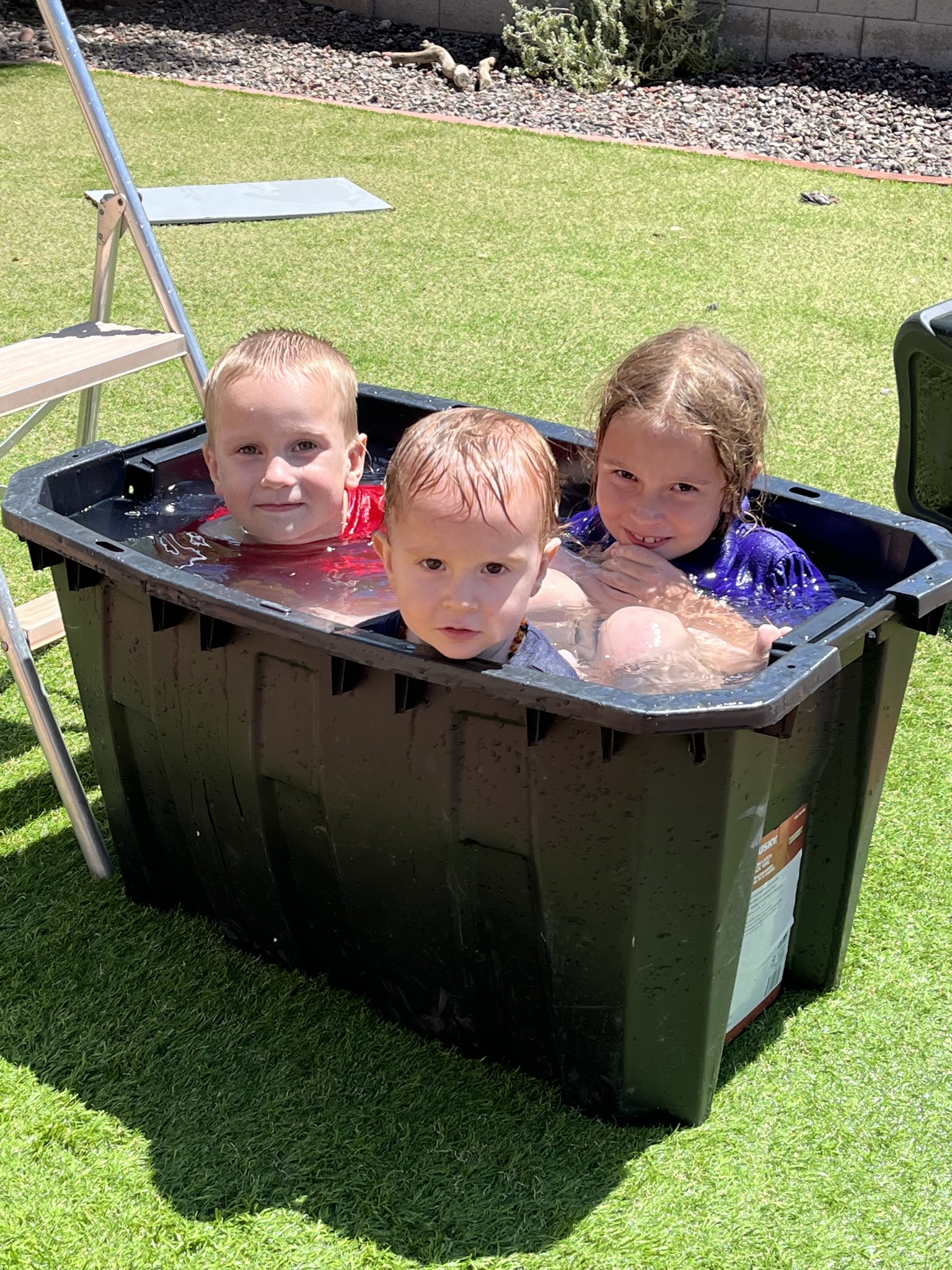
This has been a busy summer. 

Our low-budget version of a pool. Actually, we did buy a plastic pool later - three, actually, my husband got carried away - but the kids still love the storage container.

A few highlights:

- The eldest turned 17, and the baby turned 2. The eldest, amazingly enough, managed to graduate from high school, and is now working on finding a job and getting a driver's license. The baby - well, his nickname around here is "Trouble." He keeps us hopping.

- The kids attended music camp, and some of our dancers performed in an Independence Day parade.

- We managed a last-minute vacation to the mountains. 

- After working for what seemed like several hundred hours, I managed to find homes for all nine of our kittens. May we say, HUZZAH. (They were adorable little darlings - we were so sorry to see them go - but so glad they all found good homes.) 

** We used the website ReHome to find homes for two of our kitties. It is a great website with supportive staff, and the user interface is super simple and user-friendly. If you use this website to re-home pets, make sure to follow the website's recommended protocol (which includes phone interview, meet-and-greet, waiting period, a signed transfer-of-ownership, and charging a re-homing fee). All of these steps are to weed out the creeps who are looking to get easy free animals to use for base and/or evil purposes (as reptile food, dog fighting bait, animal sacrifice, animal torture, or selling to labs). Evil people are out there, and boy did we find some of them. So follow the steps to keep yourself and your animals safe! ***


One of our little ladies, whom we nicknamed "Cappy" (long story). 

- We made some more big, life-changing decisions for our family. In the last year or two, that seems to have become par for the course. At some point I'll get used to it.

- Several of our crew received Confirmation.

I am currently getting ready for an (extremely!) late start to our school year, complete with an entirely new curriculum set-up. (Translation: I ditched everything we were doing and was extremely happy to do so. It's a long story. If our new set-up works, I'll post about it next year.)


And now, onto books!


For Adults and Teens

Allergy-Proof Your Life: Natural Remedies for Allergies That Work! (Michelle Schoffro Cook, 2017) – Non-fiction health.
   I used to think that allergies were a minor complaint, similar to the "morning sickness" that women made so much unnecessary fuss about. (*Laughs sardonically*) And just as with morning sickness, I thoroughly got my come-uppance with allergies. While I don't get the worst form every year, I have been through the mill with severe seasonal allergies (which here in the Phoenix valley, oddly enough, seem to hit right around Christmas time), and have experienced the lovely type that basically brings life to a screeching halt. This book was a great resource for information about treating allergies naturally, and I enjoyed it greatly. While it goes far further than I hope I ever have to go, I adopted some of the basic strategies this past allergy season, and they helped tremendously (if I am remembering correctly, I avoided dairy and modern wheat like the plague, and added a ton of water and vitamin C to my regimen). Recommended.

Irreversible Damage: The Transgender Craze Seducing Our Daughters (Abigail Schrier, 2021) – Non-fiction sociology.
   I have wanted to read this book for several years, and I finally got my hands on it - and it did not disappoint. While the author is not a Christian - and could even be labeled technically as "pro-trans," in that she does not argue with the idea of adult "gender transitions" - she is addressing a horrendous and oft-ignored phenomenon that is sweeping through our young people - that is, the incidence of "rapid onset gender dysphoria," or gender dysphoria that comes on suddenly, with no history of such feelings or behaviors, almost always after exposure to online trans influencers and communities. She addresses specifically the skyrocketing incidence of this phenomenon in teen girls, and how this is leading to widespread body mutilation (through artificial hormones and irreversible surgeries), and how acceptance of this behavior is now mandated in most levels of our society. As one commenter said, "Science is dead and now social pressure has taken off." 
    As I have observed what is going on in our society, I have realized that had I grown up in current times, I would have been in serious trouble. I was a child with severe social anxiety, social awkwardness, someone who "always knew she was different," and who firmly rejected any feminine frills. (My mother once bought me shoes with bows. I cried.) In terms of the trans movement, I would have been easy prey.
   And here's the thing: Teens can't think long-term. I know I couldn't think long-term with any sort of reality when I was a teen. If someone had said to me, "Here are these drugs and surgeries that will prevent you from being able to have children or breastfeed," I would have said a big who cares. Pregnancy and breastfeeding meant nothing to me at that point. I could not realistically conceive of my future as a mother. But now, many years later, I have spent the past eighteen years either pregnant, breastfeeding, or both. It is a treasure and a gift from God, something that I can't imagine having forfeited in a burst of teenage immaturity. But I'm pretty sure I might have, given the right circumstances. And the fact that our society is both allowing and pushing this on enormous and growing populations of teen girls is both tragic and criminal. 
   Educate yourself about what's going on. I highly recommend this book. 

A Church in Crisis: Pathways Forward (Ralph Martin, 2020) – Non-fiction. An examination of the crises currently facing the Catholic church - a thorough and excellent treatment, and an extremely well-written one. 
   I first encountered Ralph Martin in his interview on Pints with Aquinas back in 2022, and immediately fell in love with his passion and thoughtfulness. I expected great things from his book, and it did not disappoint. Martin continually amazes me with the thoroughness of his research, and the depth of his knowledge, both of which raise the question: How can one man possibly read and examine so many books in one lifetime? (See the bibliography at the back of his book.) However he does it, he is amazing, and the book is well worth the read. Highly recommended. 

The Importance of Being Earnest and Other Plays (Oscar Wilde, c. 1895) - Drama. The edition that I read contained Lady Windermere's Fan, A Woman of No Importance, Salome, The Importance of Being Earnest, and An Ideal Husband. I had originally picked up the book to read An Ideal Husband only, as I had had to miss a children's production of that play that happened during the week of our miscarriage, but I ended up reading the whole book (I skipped Salome). I actually ended up reading all four plays over the course of one day when I was in hospital. The plays were deliciously funny and, of course, wonderfully witty. And, in fact, I went back and read the book again later just for the joy of it. If you haven't read these plays yet, I recommend them. 

That Hideous Strength: A Modern Fairy-Tale for Grownups (book #3 of 3 in the Space Trilogy, C. S. Lewis) – Fiction/Fantasy. This book was reading for Day #2 in the hospital, and it was a mind-blower. I have read this book only once before, and it was back in high school (so, about 25 years ago), and it was just as powerful as I remembered it. Being able to read it in entirety in a day was - quite literally - like having a mini-spiritual retreat. Lewis is always a winner, every time. And this is one of his most powerful works.
   Because this book is #3 of 3 in the space trilogy, I do recommend reading the first two books before venturing on this last volume. Additionally, a basic knowledge of Arthurian legendry would be helpful before delving in. Be prepared for a bit of a slow start, and then for the ride of your life. Enjoy.

Being Mortal: Medicine and What Matters in the End (Atul Gawande, 2017) - Non-fiction health.       When I saw what this book was about, I nearly put it down and didn't pick it up again. But I'm so glad that I kept reading. Gawande's book is a treasure. In this work, Atul Gawande deals with the subject of elder care and end-of-life care. How does in-home care compare with nursing home care, versus "assisted living" care? How far should treatments be pushed - especially those last-ditch treatments that can be painful, destructive, and ultimately unhelpful when taken too far? His examination of the subject, based on his vast experiences as a physician, and also interwoven with the story of his father's battle with cancer (and his eventual death), was gentle, thoughtful, evidence-based, and excellent.
   My main concern with this book was an ethical one - is he going to push for euthanasia? And my fears on that point were mainly relieved. While Gawande does briefly state that there might be a small place for euthanasia in elder care - a statement that, as a Christian, I completely and utterly reject - he states with great clarity a point that I also would argue - that the option of euthanasia makes elder care and end-of-life care far worse than when that option is not available, simply because euthanasia makes caregivers lazy (my words, not his). In other words, why worry about dignified and complicated end-of-life care plans, when one can just urge a patient to choose death and save everyone the trouble? (And a friend of mine, a health worker who witnessed the aftermath of the legalization of euthanasia in Oregon, told me that this is exactly what did happen.)
   I have seen a similar phenomenon in the hyperemesis world with the "solution" of abortion. Why worry about treating or curing complex hyperemesis, when one can "solve" the problem by killing the baby? In both cases, having an unethical false solution to a problem prevents real problem-solving from happening. It also results in lazy, immoral, and dehumanized care for the patient. In both cases, you can't use murder to get real and dignified solutions to complicated health problems.
   I enjoyed this book thoroughly, and recommend it to all, because the material is pertinent to all. All of us will have loved ones getting older or in end-of-life situations, and all of us will one day face the same situation for ourselves. Although the topic is uncomfortable, it's good to think about it before one is in the thick of decision-making and difficult choices. 
   Having enjoyed this book so much, I found several other books by the same author and am now going through those. One of them, "The Checklist Manifesto: How To Get Things Right," will be included in June's write-up of Books Lately.


Children’s Books

Little Britches: Father and I Were Ranchers (first in an eight-book series by Ralph Moody, c. 1950) - Non-fiction autobiography.
   A friend gave me this series years ago - as in, over a decade ago, I am embarrassed to say - and I have only now gotten around to reading them. They comprised some of my reading during our two months of pregnancy loss and recovery after hospitalization, so it was good that there was a lot of material to chew through. 
   These books are excellent. They have been compared to the "Little House" books, and I would say that that is a good comparison - the time period is slightly later, beginning around 1900 - and covering the author's boyhood, beginning when his family moved west to help improve the health of the father (who had tuberculosis), and following the author through his young adulthood up until his marriage. Included in the series is an unbelievable number of different situations, some of which include:

  • The family's ranch experience, ending with the father's death after a bad chill.
  • The family's life after the father's death, supporting themselves with door-to-door selling of the mother's cooking, a time which included the birth of a posthumous baby, and ends with the family having to leave town secretly to avoid the mother having to testify in a case which might lead to a man's execution.
  • The family's life in a new town in which the mother establishes a laundry business to support the family, and in which the author works in a local store.
  • The author's life with his grandfather when he is sent away to live with him for a time.
  • The author's time working on horse ranches and doing trick riding.
  • Most interestingly for me, as an Arizonan, the author's time as a young man doing stunt falls for the infant movie industry (c. 1920) in Tucson, at a time when it was common for both men and horses to be killed or horrendously injured in stunt falls.
And much more. In our current time of extended adolescence, video gaming, and other unhealthy youth predilections, this book was an amazing testimony to the ability of young people to do amazing, productive things with their lives. It was an amazing testimony.
   My one problem with this series was that there were often processes (ranching, farming, mechanical, etc.) described in great detail and at great length, and I often had absolutely no idea what was going on. This does occasionally happen in the "Little House" books, but it was far more prevalent in this series. I just had to learn to keep going and ignore those descriptions, because to a non-farmer, they were unintelligible - my fault, not his.
   If you haven't yet enjoyed these books, I recommend them. If you've read one or more, please write and tell me your thoughts on them! 

New Faces, New Friends (, last book in the Grandma’s Attic Series) – Biographical novel. The Grandma's Attic series was one of my favorite book series from childhood, and I recommend it most fondly. This last book in the series takes place when Mabel is a young married woman with a baby, and concerns the goings-on of their community in small-town 1800s America.
   My main complaint with this book is that it seems to be out of print! - which is a terrible shame. The first four books in the series are commonly available as a boxed set, but the later books in the series - which are my favorite! - are almost completely out of print. They are available as used copies, but it is a pity that they're not currently being printed. If the world at large is listening, please get these wonderful books back in print! 

Cherry Ames, Student Nurse (first book in the Cherry Ames series) – Realistic fiction.
   I bought a certain number of these books years ago at a used book sale - about seven of them, I think - and then never got around to reading them. As I have really needed extra reading material this spring due to all of the illness and recovery going on around here, I finally got this series out (along with the Little Britches series). Cherry Ames books are quick reads - all of them concerning a young woman who becomes a nurse during World War II. 
   The Cherry Ames series was begun during World War II itself, so the series is at first concerned entirely with the war. In the first book, Cherry is a student nurse. In each book, she progresses - through graduation, into practice, and onto the front lines as an army nurse. As the series passes beyond the end of the war, Cherry ends up in a variety of different non-wartime situations - a different post in each book (nursing home, school, ranch, etc.). Each book contains some type of mystery/adventure and a bit of romance, as well as a few steady characters and a continually revolving cast of new characters from each new location. Think "Nancy Drew" with a nursing theme.
   Though nursing and its duties are often described, the more personal or gruesome aspects were glossed over or ignored - something that I think is good in a children's book series.
   The wartime Cherry Ames books in many ways read like wartime propaganda - so much so that I wondered if they really were written as propaganda. Glowing descriptions of "our brave boys" and "our heroic nurses who sacrifice everything for the glorious cause" (my paraphrases) were both charming and somewhat amusing (they were overdone, but that was understandable).
   I would have no problem handing these books off to a daughter of any age. If you do so, however, don't be surprised if she comes home wanting to be a nurse! 

Bud, Not Buddy (Christopher Paul Curtis) – Realistic fiction. A young orphan boy searches for his father during the Great Depression and Jazz Age South.
   I enjoyed this book greatly. It is well-written, funny, and has a well-planned rhythm and flow that results in a very enjoyable read. Our teen son enjoyed it as well.
   My one concern with this book - and it's not a little one - is that the book is filled to the brim with both off-color references and lying. If a child is truly old enough to roll with this material and not take it as an example, I think it's probably okay. For younger children, I really wouldn't recommend this book.
   Your thoughts?

I would love to hear recommendations for great books that you've read lately (and your thoughts on them). Leave a comment below!


A few words from the kitchen...

Actually, this post is so late that I have no idea what was going on in the kitchen way back in May. Mostly, nothing. I was busy with morning sickness, then miscarriage, and then being in the hospital. For the last half of the month, people from our church were bringing us meals in a wonderful show of support and love that we treasured and appreciated. Which reminds me...

I need to write thank-you notes!

As well as catching up with super-late editions of Books Lately. 

But that seems to be life as a mother. There just isn't time - as in, for anything. (I am writing this with a toddler using me as a jungle gym. It never stops.)

So, in the meantime, have a wonderful rest of the summer. And for you non-Phoenicians, appreciate any temperatures you're having that are less than 115 outside! (Wow, it's been hot around here.)

Love to all!


One of my ongoing projects is making one pie per month this year. I think that I'm on pie #6 or #7 - not bad, especially for me. This one was, I think, apple. 


I make pineapple upside down cake for our yearly Monsoon Day celebration (June 24th, which is also the feast day of John the Baptist). Pineapples, you know! Tropical! Like monsoons are tropical! Except that we live in a desert! So you can clearly see the connection there. Too bad we have gotten exactly zero monsoon rain this year. (Not true, we did get ten minutes once, about two weeks ago. Should make for a very interesting fire season this fall.)


Not sure what this was, but it was apparently important enough to take a picture.


Saturday, July 15, 2023

The Answer for a Kitten Who WILL NOT Use the Litterbox


As y'all know, this spring our we'll-get-the-cats-spayed-sometime attitude resulted in - surprise! - two litters of kittens arriving at our home. (You want a kitten! You know you do!! Yes! Email me!) And one of the kittens, to our profound surprise, had a deep antipathy for the litterbox - as in, "You can put me in, but I. will. not. comply." Sure, he would use just about anything else - our blankets, our sheets, clothes left on the floor, the carpet itself - but the litterbox he avoided like the plague. (Our attempts to put him in resulted in his impersonation of a fully-loaded feline spring.)

We were really at our wits' end over this issue. I couldn't get sheets and linens washed before he'd ruined the next set - and, as you all know, washing cat-urine-soiled laundry is not an easy task. (Translation: I was going through one five-pound box of Biz laundry additive per week.) 

So, I headed over to our local pet supply store and begged their help. The gentleman whom I petitioned for aid directed me to (drum roll please!)...

Dr. Elsey's Kitten Attract Litter

We brought it home, made up a new litter box, and placed said erring kitten within. He sniffed! He pawed! He did not shoot out of it like a loaded cannon! And, miracle of all miracles, he used it!

And we have never had a problem with him again.

So, quick public service announcement, if you ever find yourself in possession of a renegade feline who is marching a picket line with "Won't use the litterbox!" signs, this is truly a miracle-working product. Give it a try. Our family loves it.


* I am not receiving any compensation of any kind for this product endorsement. *


Saturday, June 10, 2023

Let's talk about the use of the {Vitamin K + Vitamin C} Protocol to Treat Morning Sickness and Hyperemesis Gravidarum


This spring, I was super-excited about something that I hoped to publish next year - namely, that I had found something that helped my morning sickness.

If that's not earth-shattering, nothing is.

However, when we miscarried our baby in mid-May (at 11w4d), there were signs - no definites, but certainly strong indications - that our baby may have died long before the actual miscarriage, possibly at the very beginning of the pregnancy. This often results in a pregnancy with reduced pregnancy symptoms. Thus, I can no longer state with any authority that I have definite results for this method working for me.

However, I can say this:

(1) I did still have strong pregnancy nausea, starting at the usual time (3w4d), and

(2) I noticed definite improvement when I used this method - both when I started it, and again when I increased the dose.

That being the case, I wanted to present the data to my readers so that they can do the research themselves, and discuss it with their midwives/physicians. Let's get started.

Before we start, let's quickly differentiate between a remedy and a coping mechanism.

These are my terms, not taken from any source. 

In my personal terminology for pregnancy nausea, a remedy and a coping mechanism are different entities. A remedy is something that actually reduces my pregnancy nausea. A coping mechanism, on the other hand, is something that, while not reducing my absolute level of pregnancy nausea, helps me to cope at the nausea level where I am. Does that make sense?

Coping mechanisms are legion. Some that I use include a protein shake before bed, eating immediately upon getting up, getting more sleep, dropping outside activities, etc. We all have these.

Remedies, on the other hand - something that actually works to reduce my base level of nausea - are incredibly rare. That is, they are a dime a dozen - just check the internet! - but the ones that have actually worked for me are virtually zero. Here are some of the ones that I've tried:

  • Bentonite clay
  • Ginger
  • Preggie pops
  • Eating hardboiled eggs before bed
  • Herbal morning sickness remedies
  • Weekly B6/magnesium shots
  • Probiotic therapy
  • Basic dietary changes (Paleo, gluten-free, dairy-free, etc.)
  • Dramamine
The only remedies that have worked so far for me would include the following:
  • Very-low-carb diet, done for 6+ months pre-conception 
  • Medications (Unisom, Zofran)

As I never want to do the very-low-carb diet again (and didn't have time anyway, as this pregnancy surprised us), and I hoped to avoid medication, finding another remedy that worked was super-exciting.

What "it finally worked" method are we talking about?

I refer to the Vitamin K + Vitamin C remedy.

If you've spent more than 30 seconds online researching morning sickness remedies, you have run across the Vitamin K + Vitamin C remedy for morning sickness. Trouble is, there's almost no information, details, or advice on how to make it work. It will inevitably be cited thusly:

"Vitamin K and vitamin C , taken together, may provide relief of symptoms for some women. In one study, 91% of women who took 5 mg of vitamin K and 25 mg of vitamin C per day reported the complete disappearance of morning sickness within three days."

I see that I actually posted that information on my blog when I discovered the reference - specifically in 2008 (over fifteen years ago!) - in the article Research: Vitamin K and Vitamin C.

But although I have known about this for many, many years, I have always feared to try it due to the high dose of vitamin K involved. (Daily dietary needs for vitamin K are usually listed in micrograms.)

However, this time around, I really wanted to stay off of medication. (Don't we always.) So I started researching to see if I could find out more - both about safety and efficacy. Firstly, I found this article giving some details about the protocol:

Morning Sickness: Vitamins C & K

Looking up the doctor mentioned in that article, I found a presentation of the detailed results of the study mentioned above - go to slide 35 in this presentation by Dr. Jeremiah Wright.

The basic results of the 1952 study were to have been as follows (quoted from the above presentation): 

"In the study, 70 women with mild to severe nausea and vomiting of pregnancy took simultaneously each day vitamin K3 (5 milligrams) and Vitamin C (25 milligrams).

                ▪ 64 reported complete remission in 72 hours.

                ▪ 3 were relieved of vomiting, but not nausea.

                ▪ 3 obtained no relief."

In it, he also gives the citation for the original study - here it is, for anyone who wants to look it up: 

Merkel RL. The use of menadione bisulfite and ascorbic acid in the treatment of nausea and vomiting of pregnancy: a preliminary report. Am J Obstet Gynecol 1952;64:416-418

I also found a podcast/radio show in which Dr. Wright discussed his efforts to publicize this method of pregnancy nausea control:

Nausea Caused By Pregnancy and Preventative Vitamins 

I also found another doctor discussing his use of K2 (in the form of intramuscular injections) for pregnancy nausea. He discusses a case in which K2 injections did not work - or did not work on their own - but his background experience was that this method almost always did work:

Hyperemesis Gravidarum: Reversing Autotoxic Hormone Reactivity/Antihormone Therapeutics

He writes:

"Until this year I have had nearly 100% success with intramuscular administration of vitamin K2 (menatetrenone) 2 cc at 10 mg/cc for nausea and vomiting (N/V) of pregnancy in scores of patients. Thanks to Jonathan Wright, MD, for teaching this many years ago... With N/V of pregnancy, I usually administer vitamin K2­ 2 cc daily for the first couple of days until the N/ V stops and then weekly or as needed. Sometimes one shot stops it for the whole pregnancy."

I also found, when I looked up my own post from back in 2008, the following quote from another physician:

 "For morning sickness, I recommend 100 to 200 milligrams of B-6 and 10 milligrams of vitamin K a day. Occasionally, more than 200 milligrams is necessary, but this amount should be taken under a physician's supervision. I also give patients an initial injection of vitamin K, which works in a day or two. Taken orally, the Vitamin K takes somewhat longer to produce results - about ten days." - Superimmunity for Kids by Leo Gallard & Dian Dincin Buchman, p. 47

Safe and effective? This was super-exciting stuff. But...

Are high doses of vitamin K safe for pregnancy?

There are two questions: (1) Are high doses of vitamin K safe in general, and (2) Are high doses of vitamin K safe for pregnancy.

The research that I found was surprisingly reassuring. Besides the doctors quoted above (all of whom used very high doses of vitamin K with pregnant women, with great success and good outcomes), I found a number of physicians quoting the use of very high dosage vitamin K as safe for both pregnancy women and the general population. Here are some of them:

For the general population:

From LiveStrong:

"The recommended daily intake for vitamin K set by the Food and Nutrition Board of the National Academies of Medicine (FNB) is 120 micrograms for men and 90 micrograms for all women, including those who are pregnant and breastfeeding. These RDAs aren't hard to achieve through a balanced diet, and the National Institutes of Health reports that vitamin K deficiency is very rare.

"The FNB sets upper, tolerable intake levels (ULs) for vitamins that pose health risks when taken in excess. However, there is not a UL for vitamin K, because there have been no reported adverse effects from vitamin K excess in any amount from food or supplements in the general population." (emphasis added)

From National Biochemistry (NBI):

"The amount of MK4 (a type of vitamin K) used in studies is 45-135 mg, which is 500 to 1,500 times greater than the IOM adequate intake. Thus, an important question is whether or not it’s safe to consume vitamin K at this high dose. The short answer is unambiguously, Yes. MK4 is safe even at doses much higher than the top amount used in clinical trials.

"US Institute of Medicine (IOM) conclusion:

"The Tolerable Upper Limit (TUL) is the highest daily dose that is safe for almost all individuals in the general population to take on an ongoing basis. The IOM concluded that for natural forms of vitamin K, of which MK4 is one, there is no known TUL. This means that the IOM considers vitamin K to be extremely safe, even at very high doses." (emphasis added)

From WebMD:

"When taken by mouth: The two forms of vitamin K (vitamin K1 and vitamin K2) are likely safe when taken appropriately. Vitamin K1 10 mg daily and vitamin K2 45 mg daily have been safely used for up to 2 years. It's usually well-tolerated, but some people may have an upset stomach or diarrhea." (emphasis added)


 For pregnant women: 

 From Sanford Health, showing that high doses of vitamin K are used therapeutically during pregnancy already, for purposes other than pregnancy nausea:

"Vitamin K is important in helping blood clot. Though extra vitamin K is not needed during pregnancy, women who are pregnant and using anti-seizure medications are at increased risk of vitamin K deficiency in their baby. These women should take oral vitamin K, at a rate of 10 mg daily, from 36 weeks until delivery." (emphasis added)

From Oxford Academic (Volume 78, Issue 10, October 2020), regarding high doses of vitamin K for use in osteoporosis in pregnant women:

"Vitamin K2 at 45 mg/d has been used as a safe treatment option in a case series of pregnancy-associated osteoporosis... There is no known toxicity for vitamin K2, and no tolerable upper level has been set for either K1 or K2 in pregnancy as there have been no studies on reproductive or teratogenic risk." (emphasis added)


When you start looking at links, opinions do vary. Some do not recommend vitamin K supplementation during pregnancy. Some say it's okay up to a point. Some say that it's perfectly safe and that there is no upper limit on safety. For myself, I was confident from my reading that therapeutic doses of vitamin K were safe during pregnancy. 

Additionally, it has to be taken in perspective. If I do supplement with high doses of vitamin K, and it works, then I am exposed to a very-mostly-likely safe vitamin. If I don't supplement with vitamin K, then I will most certainly be taking Unisom (doxylamine succinate), which is an artificial drug and has been several times implicated in risks for the unborn child. I think I'd probably take my chance with an all-natural, already-present-in-the-human diet supplement if I have that choice. 


Who should not supplement with vitamin K:

The only firm contraindication seems to be for people who are taking the drug Warfarin. From the NBI article:

"People who take the drug warfarin (Coumadin) should not take MK4. Warfarin is a blood thinner that works specifically by blocking vitamin K’s actions in the blood clotting cascade. Providing vitamin K as a dietary supplement counteracts warfarin. People taking warfarin should absolutely not take MK4 and they shouldn’t take any vitamin K-containing products without first consulting their healthcare provider." 


What about the different forms of vitamin K?

Vitamin K is actually a family of closely-related vitamins, rather than a single compound. There are three forms of vitamin K:

Vitamin K1 and K2 (and there are two forms of K2) are found in nature and are naturally present in the human diet.

Vitamin K3 is an artificial form.

There are some concerns with toxicity from high doses of vitamin K3 - although the doctor mentioned above still used it very successfully for morning sickness treatment. 

Vitamin K3 is not available over the counter in this country at the present time (that I know of). Vitamin K1 and K2 are widely available and can be purchased over the counter (OTC).


How I put this protocol into practice, and how it worked for me:

This spring's pregnancy was a complete surprise - it was much sooner than expected, and at my age, I wasn't sure if another baby would be on the horizon at all for us. So I was not doing any preparations at all - no dietary changes, no supplements, no nothing. 

I got a positive test - quite randomly! - at about 3w4d. My pregnancy nausea started, much to my annoyance, later that same afternoon. While it may or may not have been as strong as with a healthy pregnancy, it was definitely present, strong, and followed my usual pattern. (Week 3 = nausea starts. Week 4 = I'm still okay. Week 5 = I need help.)

I immediately started researching the Vitamin K + Vitamin C method (for some reason, it came to mind strongly in a way that it hasn't in previous pregnancies). I believe that I started using it at 4w2d. And here's the thing: I felt an immediate and powerful improvement in my nausea levels. (Translation: I took the remedy at night, and felt much better the next day.) And while I continued to feel worse as the pregnancy progressed (which is normal), I was functional. I could get up on time, and eat most foods. I did not have to obsessively eat the same thing over and over until my cravings changed. I did not need to take medication. I could keep things down. While I had a lot more on-the-couch time, I was much more "okay" than usual. I didn't descend into the depths of despair. And I only threw up about five times, total. It wasn't a miraculous nausea-cleared-up-completely! sort of thing, but it was profoundly effective and positive. If I'd increased the dosage more - which, again, I wanted to do but was afraid to try - it is very possible that I would have seen even more awesome results. 

I ran into two snags with the protocol:

(1) The original protocol wording that I found said to use the method for a month. That landed me straight into week 8, when I was feeling pretty awful and was in no way ready to give it up cold turkey.

(2) During week 9, I started feeling that I need some extra help. My two options were to increase my dose of vitamin K, or to go back to using the Unisom protocol to some extent.

In an effort to get more information, I reached out via email to two of the doctors referenced in the articles above. To my surprise and dismay, I never heard back from either of them. This was a deep disappointment, as I would have greatly valued their input and advice regarding this method, and was willing to pay consultant fees. If I had felt more confident and energetic, I would have called up their offices to try to deal with the red tape involved in consulting them through their official practices. However, I was feeling (1) awful enough not to be up to the challenge, but (2) not awful enough to be desperate. So that didn't happen.

Another option for me would have been to go to the naturopathic college medical clinic that we have here in the Phoenix valley. However, the same attitude of "I feel too awful to go, and not awful enough to be desperate" kept me from trying it this time. However, I would definitely be up for that in the future. This would be a good way to consult a physician regarding dosage safety, as well as to have the IM injection method of delivery possible, which is often more effective than oral delivery, but which I cannot do at home. 

Some of this information above regarding the safety of super-high dosages of vitamin K I actually didn't see until writing this article, which I regret, because I would have continued to increase the dosage when I felt that I needed it if I had felt comfortable with the safety. As it was, I did increase my vitamin K dose during week 9 to about 7.5 mg, and again felt an immediate improvement. I held that dosage steady until our loss at 11w4d.

Some may wonder if the placebo effect had anything to do with my improved levels of nausea, and to that I will say that I am sure that there was no placebo effect going on. 

Some years ago, I read in "The Case for Miracles" (Lee Strobel) that some conditions are well-known for being vulnerable to improvement due to the placebo effect; other conditions are much less affected by it (in the book, the example given was hearing loss).

In my experience, I have found that pregnancy nausea is not at all affected by the placebo effect - I have tried so, so many nausea remedies, and no matter how much I want a given remedy to work, or how I believe that it is going to work, or how I know that it has worked for other people, pregnancy nausea just doesn't budge. It is implacable. I think other pregnancy nausea mamas will back me up on this one. So when I find something that I sense really works, I have no problem in being confident in my assessment, simply because I have seen how ruthless pregnancy nausea is, and how unaffected it is by my wishes and beliefs. 


A few details:

For vitamin K, I used the Super K supplement - two pills at first, and then three when I increased the dosage at 9 weeks.

For vitamin C, I just used an over-the-counter 1000 mg vitamin C pill. The protocol calls for an absurdly low amount of vitamin C (25 mg), but there is no absolute need (that I know of) to achieve that low dosage. 

My conclusions:

* I believe that the Vitamin K + Vitamin C combination is safe, and I have experienced that it is effective. 

* To say this authoritatively, though, I would have to use it throughout a healthy pregnancy with full symptoms.

* I do not believe that using this protocol caused our miscarriage, as physical evidence showed likelihood of a very early loss - possibly even before I began using the protocol.

* I do not know if this method could help HG sufferers - though several of the doctors above stated quite firmly that it could - but I believe that it would be a good auxiliary treatment even if other treatments were used at the same time. 

* As usual, I think that the best time to research all of this would be pre-conception, when one is not panicking over rising nausea levels. I plan to make some contacts and appointments to discuss this with caregivers, in order to be ready for next time, should there be a next time. (Very likely there won't be, at my age, but one likes to be prepared.)


I would love to hear thoughts, experiences, or input. As always, comments must be rational, conversational, and kind, and offered in the spirit of charity (i.e. no "you are an idiot, woman!" comments). 

I very much hope that this information can be of use to mamas out there. 


As always, this is not medical advice. Take the information and the articles to your midwife, OB, naturopath, or other physician. and get his/her take on it.  


Thursday, June 1, 2023

A Spring Full of Unexpected Surprises (Books Lately, April 2023)


I originally styled this post as a fun-and-funny pregnancy announcement for baby #8, whose due date would have been sometime around Thanksgiving, and whom we ended up losing in May at the end of the first trimester. I will get around to telling that story sometime. 

The same weekend that we discovered that we had gained a new team member, we also noticed that both of our adopted strays were looking... suspiciously plump. And yes, they were both expecting. April brought, along with morning sickness for me, two litters of kitties - five on Easter Monday, and four more two weeks later. 

We are now trying to find new homes for said kitties. Do y'all know how hard it is to find people who want kittens? Yowza. We have notified social media, my husband's coworkers, our family, our church, the homeschooling community, neighbors, and practically everyone we've known or met over the past forty years - and have had very little luck. Still working on that problem.

In the meantime, we are enjoying said kitties - there's nothing like opening a sock drawer and finding it full of kittens.


From litter #1
From litter #2


And so, continuing where I left off...

If you're all wondering why I have an insanely long list of books this month, pregnancy nausea = lots of neglected housework + lots of down time spent reading. I have also been doing a lot of pre-reading for three literature-based homeschool courses (Modern History, British Lit 1, British Lit 2) that I am writing for our 16yo. When those lists are finished, I will definitely publish them here!

One note: I have considered the issue of whether or not to note my negative impressions of books that I read. The "only positive things" rule is a possibility, and not a bad one. However, it could also be considered as less than completely honest - and I also do not want to be guilty of recommending books without adding warnings about potential textual pitfalls. Thus, I will attempt to be positive in the main, and will do my best to observe the law of charity when I do feel the need to add a negative note about any book.

One other note: I love back-and-forth conversation - just not trolling and "you are so stupid" comments. Please feel free to engage in discussion, as long as it is rational, conversational, and kind. 


Palo Verde blossoms - the desert's last gift to us before the summer grind begins. 


Books Lately, April 2023


For Adults

Under the Tuscan Sun: At Home in Italy (Frances Mayes) – Nonfiction narrative. An American couple buys and renovates a vintage home in rural Italy. Filled with details about their home renovation and their life in Italy, with lots of funny interactions with locals and adventures in learning about Italian life. The one downside is that the book at times felt interminably long. However, it was a good read, and I enjoyed it. There is a sequel that I have not yet read: "Bella Tuscany: The Sweet Life in Italy."

If you enjoy this genera, you might enjoy one of my favorites, "A Year in Provence" by Peter Mayle. The setting is rural France. 

The Last Bookshop in London: A Novel of World War II (Madeline Martin) - Historical fiction. A young woman, moving to London, works in a bookshop during the London Blitz. Enjoyable, readable, fun. Not a deep book or a deeply memorable book (a month later, I can barely remember reading it - though that's probably my fault, not hers), but good. My one worldview pique was a brief flare of feminism (my lifetime arch-nemesis), but otherwise, fun and unobjectionable. And a book in praise of books? Gotta love it. 

Hello, Habits : A Minimalist's Guide to a Better Life (Fumio Sasaki) – Remember the fellow whose minimalist lifestyle allowed him to pack his apartment, move, and unpack his things in his new apartment... all within 90 minutes? He's back with a sequel to the original "Goodbye Things: The New Japanese Minimalism" - this time a book about habit formation. I enjoyed this very much.

Forever, Erma: Best Loved Writing from America's Favorite Humorist (Erma Bombeck) - I remember my mother having books by Erma Bombeck, so was interested to see what I thought as an adult of her writing. Reading her was great fun. While the writing is now dated, and I didn't agree with all of her opinions, there is no doubt that she was a kind and funny lady. I was especially interested to learn that she lived and died in my current home city - a fun and surprising discovery. 

Jesus and the Jewish Roots of the Eucharist (Brant Pitre) – I've heard about this book for years, and it really was as good as everyone said it was. This was doubly meaningful for me, as I have an unfortunate tendency to find anything concerning the Old Testament rather dull. But dull this book was not. I'm looking forward to reading Pitre's other works. 

The Decadent Society: How We Became a Victim of Our Own Success (Ross Douthat) – In this book, Douthat details societal decadence - moral laxity, self-indulgence, the waning of innovation, etc. - and examines the West in this light. The big question, then, is where will we go from here? Will the West fall to a more vibrant and virile civilization? Will we experience renewal from an unknown source? I enjoyed this book - certainly the first half. After that, I felt that it got more diffuse and wandering - perhaps not surprising, as the "what next?" question could possibly go in so many directions. While I love Douthat, this wasn't my favorite of his books - but it was an interesting read. If you read the comment section in the link above, you'll see people giving great for-and-against arguments for this book. I recommend skimming them.

The Battle for the American Mind: Uprooting a Century of Miseducation (Pete Hegseth) – This one definitely wins an award for this month - it was a wonderful and very important book. The text comprises a history of American/Western education, with an especial focus on the concept of paideia - something that is difficult to translate into English, but comprises elements of a civilization's spirit, worldview, source of culture, and vision of the good life. From the book, "Paideia, simply defined, represents the deeply seated affections, thinking, viewpoints, and virtues embedded in children at a young age, or, more simply, the rearing, molding, and education of a child." The author shows how the paideia of American education has progressed from traditional Christian/Western paideia into progressive paideia and is now fully controlled by Marxist paideia - and the answer to that problem. Whether you have children in school, or school them at home, this issue is vitally important to all of us. I highly recommend reading this book, and passing it on to others. 

Warriors Don’t Cry: A Searing Memoir of the Battle to Integrate Little Rock's Central High (Melba Pattilla Beans) – Non-fiction narrative. One of the original black students to enter Little Rock High School tells the hair-raising tale of her time at that school. A heartbreaking story. While I had heard for years about this event, I had no idea that it was so intense and long-lasting. I highly recommend this book. 

To Love and Be Loved: A Personal Portrait of Mother Teresa (Jim Towey) – Biography and memoir. Written recently by a man who knew Mother Teresa personally. While I grew up hearing of Mother Teresa, I knew almost nothing about her. This book was an absolute joy to read. Highly recommended. 

Tolkien: Man and Myth (Joseph Pearce) – Biography. I was a latecomer to the hobbit party. As a child, I was not particularly fond of "The Hobbit," and I found "The Lord of the Rings" completely mystifying. (It didn't help that Tolkien had a penchant for choosing close-sounding names - Eowyn/Eomer, Theoden/Theodred, and my all-time mystery, Sauron/Saruman. I never knew what was going on.) But after falling in love with the movie trilogy (the first one, not the second one), I gave LOTR another try - and fell in love. Tolkien's worldview and theological insights are some of the deepest I've found - and he manages to convey them perfectly without a hint of any formal religion at all. I have now read LOTR multiple times - at least once a year - and love it more each time. Reading this biography of Tolkien was a joy. 

How to Ruin Your Life By 30: Nine Surprisingly Everyday Mistakes You Might Be Making Right Now (Steve Farrar) - Christian non-fiction. A book for teens and young adults, giving wisdom on how not to make a mess of their getting-started years. My feelings on this book were mixed. On the one hand, I felt - quite frequently - that some issues were soft-peddled and were never quite addressed with the firmness and clarity that I thought necessary. However, he obviously wrote from the heart, and he had good advice. I especially liked his description having written down, while in college (or thereabouts), a list of his "strong Christian" friends, and seeing, through the years, how a huge majority (I believe it was 50 of 53) later walked away from Christ. This matches my experience. It's a sobering wake-up call - just because you have a strong faith as a young person does not mean that you'll keep it. (I'm thinking of Joshua Harris.) Anyhow, while this book didn't quite meet my expectations, I appreciated it. Also, this is - I believe - actually a sequel, written for a younger crowd, to the original book, "How to Ruin Your Life By 40," which I haven't yet read. Let me know if you've read that one, and if so, what you thought of it. 

The Four Witnesses: The Early Church in Her Own Words (Rod Bennett) - A biographical account of four of the earliest church fathers - Clement of Rome, Ignatius of Antioch, Justin Martyr, and Irenaeus of Lyons - relying heavily on their personal writings and the writings of their contemporaries. I was prepared for this to be on the dry and dull side; to my surprise, it was not. It was fascinating! I am looking forward to reading the sequel, Four More Witnesses: Further Testimony from Christians before Constantine (which covers the lives and writings of Hermas, Clement of Alexandria, Hippolytus, and Origen). The author, Rod Bennett, has also written numerous other books, which I hope to check out soon. 


Re-reads

Rose Cottage (Mary Stewart) - I was a huge Mary Stewart fan in high school - especially of her Arthurian series. (Warning: contains highly inappropriate material; I recommend editing if you are going to have these around.) "Rose Cottage" is a light romance novel in post-WWII England, and it's always been a favorite. It is, however, hard to ignore one of the main themes of the book - to wit, that "sexual immorality isn't the problem, it's the religious meanies who dare to criticize it who are the problem." And I answer to that, nope, God gave us moral rules for a reason, and they should be obeyed and enforced, for a reason. So, while I still enjoy this book immensely, I am not unaware of the underlying moral problems with the worldview presented therein. 


For Children & Teens

A Long Way From Chicago (Richard Peck) – Tall-tale style fiction. A boy and girl stay with their eccentric grandmother during the Great Depression. The downsides are occasional vulgarity and a great deal of lying (from the grandmother!) - the positives are a well-written, funny story, done in a quasi-tall tale style. After considering it, I passed this book on to our eldest, and he loved it. There is a sequel, "A Year Down Under," which I also enjoyed.

The Blackbird Girls (Anne Blankman) – Historical fiction. Two girls become friends as they deal with loss and change in the wake of the Chernobyl disaster. Oh, boy, did I ever have mixed feelings about this book. On the positive, it's an incredible story, and very well-written. On the negative, the author chose to include extremely dark family themes into the story - a father who beats his daughter and intentionally burns her with a lighted cigarette, a mom's boyfriend who forces the mother to beat her daughter, and the girl who eventually is aided in escaping from her family and goes far away to live incognito with another family. While I otherwise loved this book, I chose not to add it to our family reading list due to the dark themes. If you are considering giving this book to your teens, I recommend pre-reading first. 

The Story That Cannot Be Told (J. Kasper Kramer) - Historical fiction. A girl and her family survive  the last days of Communist Romania. Sorry to say, I just couldn't get into this book. No serious objections, though. If you love this book, write and tell me about it. 

The Hobbit (J. R. R. Tolkien) - Fantasy. I just finished reading this aloud to our children. Surprisingly - I have never been a huge fan of this book - I enjoyed it much more as a read-aloud than I did reading it personally, probably because reading it aloud kept me from skipping all of the descriptive parts! Our children loved this. 

Rufus M. (Eleanor Estes, #3 of 4 in the Moffats Series) - Fiction. I have mentioned the Moffats series before, and I just love it. Slow-paced, gentle, innocent, with hilariously funny artwork - it is a beautiful piece of early-twentieth-century Americana. There are also lots of learning moments about life a hundred years ago - coal-burning stoves, horse-drawn conveyance, kerosene lanterns, etc. Highly recommended. 

Swallows and Amazons (Arthur Ransome) – Fiction. I love this book! Wonderfully gentle and funny, with plenty of children-only adventure that always appeal to young readers. (Think the Boxcar Family series, Enid Blyton's Adventure series, Carol Ryrie Brink's "Baby Island," - all of those wonderful books in which children have on-their-own adventures.) I also love all of the literary allusions (which illustrate to me how poor my own education was - it's always good to be humbled) and all of the folk songs and sea chanties that the children sing together (which similarly illustrate to me the declining level of our own current culture, in which most folk songs have been eliminated). All joking aside, it's good to see glimpses from healthier times to guide us in remaking our own family cultures amongst the wreckage of the West. I find books like this both convicting (culturally and educationally speaking) and encouraging. The one hard part about this book is that it is filled to the brim with sailing terminology, which to a non-boater like myself is rather unintelligible. Some time ago, I did attempt to learn the terms by watching instructional sailing videos, but it did not help. I think that sailing must be best learned hands-on. However, this book is a treasure. It is also the first in a rather large series, all of which I hope to collect. 

Half Magic and Seven Day Magic (Edward Eager) – Fiction. Whether you like these books or not will depend on your stance on the use of magic in literature. If you're okay with it, these old books (and others by Eager) are charming. Their artwork is delightful, and they are also filled with literary allusions to other works (E. Nesbitt, etc.), which make them an ever-evolving joy.

A Bear Called Paddington (James Bond) – Fiction. We all love Paddington! He is one of the great classic British characters, along with Winnie the Pooh and others. We love the sweet hilarity of this book. 

The Four-Story Mistake (Elizabeth Enright, #2 of 4 in the Melendy Quartet series) - Realistic fiction. I grew up on the Melendy Quartet series, and adore it. In my mind, it is a picture of ideal childhood - what everyone's childhood ought to be. (I'm not talking particular details, like having one's mother die, but in  the sense of joy, love, freedom, innocence, the outdoors, and a truly joyful family experience.) I use these often as read-alouds. If you haven't yet caught up with this delightful series, you're in for a treat. 


And a few recipes, but not many, since I wasn't actually cooking during the past month or two. (Unless pouring cold cereal counts as "cooking."):

Hot Cross Buns - For Ash Wednesday or Good Friday. Delicious. 

Keto Lemon Cheesecake Bars - Nobody liked it but me, but I thought it was great! (That's pretty much the fate of all low-carb desserts around here.)


And with that, I wish you all a happy and blessed Eastertide! Have a wonderful month, and I'll see you all next month!